Top 10 AI Tools for Marketing Teams in 2026 (Free and Paid)
Ten AI tools that actually earn their place in an Indian marketing team, with rupee pricing, the job each one does best and a low-cost stack to start with.
The best AI tools for marketing in 2026 are ChatGPT, Google Gemini, Claude and Perplexity for writing and research, Canva Magic Studio for design, Google Ads and Meta Advantage+ for paid media, ElevenLabs for voice, Semrush for SEO and Zoho Zia for CRM. Most Indian teams need only three or four of them, and several are free.
That last point matters. Every week a new tool promises to replace your content writer, your designer and your media buyer. In practice, the teams getting real output from AI pick a small stack, learn it properly and build simple workflows around it. This list is written for that kind of team: a D2C brand, a small agency or an in-house marketer in Pune or Jaipur working with a sensible budget.
How we chose these AI tools for marketing
Each tool on this list solves a specific, recurring marketing job and has a usable free tier or a price that makes sense in rupees. We left out tools that are only wrappers around ChatGPT with a nicer interface and a higher bill.
We looked at four things:
- Job fit. Does it do one marketing task clearly better than doing it by hand?
- Indian pricing and payments. Rupee billing and UPI support, or at least a small dollar price that a freelancer can justify.
- Indian language support. Hindi and regional-language output is no longer optional for many brands.
- Data and brand safety. Can you keep client data out of model training and keep outputs on brand?
Prices below are what the plans typically cost at the time of writing. AI companies change plans and introductory offers often, so always check the live checkout page before you pay.
Free playbook
Get the free AI for Marketers Playbook
A 25-page guide covering choosing AI tools, prompting, a 60-prompt library, AI for SEO, ads, social, email and analytics, automations and quality control. We email it to you, plus occasional new guides. Unsubscribe anytime.
The top 10 AI tools for marketing teams
Here is the shortlist, grouped from general assistants to specialist tools. Start with one assistant and one channel-specific tool, then add the rest only when a real bottleneck appears.
1. ChatGPT: the all-round assistant
ChatGPT is still the default starting point for most marketers. It handles first drafts of ad copy, email sequences, blog outlines, customer persona research and quick data analysis when you upload a CSV of campaign results.
In India, ChatGPT Go costs ₹399 a month and Plus costs ₹1,999 a month, both payable by UPI or card, according to OpenAI’s pricing page. Go is enough for most solo marketers. Plus makes sense if you lean on deeper reasoning, image generation or custom GPTs for repeat tasks, such as a GPT trained on your brand voice document.
Best use: creating 20 headline variations for a Meta campaign, then shortlisting the five that sound most like your brand.
2. Google Gemini: best if your team lives in Google Workspace
Gemini’s advantage is where it sits. If your briefs live in Google Docs, your reports in Sheets and your conversations in Gmail, Gemini works inside those files rather than in a separate tab.
Google’s India subscription page lists AI Pro at around ₹1,950 a month, and the cheaper AI Plus plan launched at an introductory ₹199 before moving to ₹399. AI Pro also bundles extra Google storage, which many teams were paying for anyway.
Best use: summarising a 40-tab campaign sheet, or drafting a client update from last month’s email thread.
3. Claude: best for long documents and careful writing
Claude from Anthropic is strong at reading long material and writing in a measured, natural tone. Marketers use it to digest a 60-page research report, compare competitor landing pages or rewrite a dull product page without making it sound robotic.
There is a free tier, and the Pro plan is typically priced around $20 a month, billed in dollars. It is a good second assistant if ChatGPT’s writing starts to feel repetitive.
Best use: turning customer interview transcripts into a messaging framework.
4. Perplexity: best for research with sources
Perplexity answers questions with citations, which makes it useful when you need facts you can check. Use it for market sizing, competitor news, platform policy changes and quick “what changed in Meta Ads this quarter” briefings.
Many Indian users got a free year of Pro through the Airtel offer that closed in January 2026. If you are on the free tier now, it still handles most everyday research. Always click through to the cited source before you quote a number to a client.
Best use: building a one-page competitor brief before a pitch.
5. Canva Magic Studio: best for fast, on-brand design
Canva’s AI features (Magic Design, Magic Resize, background remover and text-to-image) let a marketer without design training produce decent social creatives, carousels and display banners. The Brand Kit keeps fonts, colours and logos consistent across the team.
Canva Pro is typically priced in the ₹4,000 to ₹4,500 a year range in India, with AI usage limits on each plan. For a small brand posting daily on Instagram, it often replaces a part-time designer for routine work, though not for campaign key visuals.
Best use: resizing one festive-sale creative into story, feed, banner and WhatsApp formats in minutes.
6. Google Ads AI features: Performance Max and AI Max for Search
Some of the most useful AI tools for marketing cost nothing extra because they are built into ad platforms. Google’s Performance Max uses your assets and conversion data to find customers across Search, YouTube, Display and Gmail. AI Max for Search extends keyword matching and writes ad text based on your landing pages and search intent.
These features only work as well as your data. Clean conversion tracking, enough conversions per month and strong negative keyword lists matter more than the AI setting itself. Check the search terms report every week so automation does not spend your budget on irrelevant queries.
Best use: scaling a Search campaign that already converts, not rescuing one that does not.
7. Meta Advantage+: AI for Facebook and Instagram ads
Meta’s Advantage+ campaigns automate audience, placement and budget decisions, and its generative tools create background variations, text variations and image expansion inside Ads Manager. For Indian D2C brands running on Meta, this is where most AI value shows up first.
The trick is creative volume. Advantage+ needs several genuinely different ad concepts to test: a founder video, a user-generated review, a product demo and a price-led static. AI can produce variations, but the core ideas should still come from your understanding of the customer.
Best use: letting Meta find buyers for a proven product while you focus on new creative angles.
8. ElevenLabs: best for voiceovers in Indian languages
ElevenLabs generates natural-sounding voiceovers and supports Hindi and several other Indian languages. Marketers use it for reel voiceovers, explainer videos, ad variations in multiple languages and quick audio drafts before booking a voice artist.
There is a free tier with limited characters, and paid plans start at a few dollars a month. Read the licensing terms for commercial use, and never clone a real person’s voice without written consent.
Best use: producing the same 30-second product video in Hindi, Tamil and English for a regional campaign.
9. Semrush: best for AI-assisted SEO and content research
Semrush combines keyword research, competitor analysis and site audits with AI writing and content scoring tools. It also now tracks how brands appear in AI search answers, which is becoming a real reporting need for SEO teams.
It is expensive for freelancers, with paid plans typically starting above ₹10,000 a month when converted from dollars. Small teams can start with free tools and move to Semrush once SEO is driving real revenue. Our guide to using AI content for SEO safely explains how to keep AI-assisted articles helpful enough to rank.
Best use: finding content gaps where competitors rank and you do not.
10. Zoho CRM with Zia: best AI CRM for Indian small businesses
Zoho is an Indian company, prices its plans in rupees and includes its Zia AI assistant across CRM and marketing apps. Zia can predict which leads are likely to convert, suggest the best time to contact them and flag unusual drops in sales activity.
Entry CRM plans typically cost under ₹1,000 per user a month when billed annually, which makes it far easier to justify than global CRMs priced in dollars. HubSpot’s free CRM with its Breeze AI features is a good alternative if you prefer its interface.
Best use: scoring leads from Meta lead forms so your sales team calls the warm ones first.
AI tools for marketing compared: price and best use
This table summarises the list so you can pick a stack quickly. Prices are typical starting points for paid plans in India and will change, so treat them as a guide.
| Tool | Main job | Free option | Typical paid price |
|---|---|---|---|
| ChatGPT | Writing, ideation, analysis | Yes | ₹399 (Go) to ₹1,999 (Plus) a month |
| Google Gemini | Work inside Docs, Sheets, Gmail | Yes | ₹399 (AI Plus) to ₹1,950 (AI Pro) a month |
| Claude | Long documents, careful writing | Yes | Around $20 a month |
| Perplexity | Research with citations | Yes | Around $20 a month |
| Canva Magic Studio | Social and ad creatives | Yes | About ₹4,000 to ₹4,500 a year |
| Google Ads AI | Search, YouTube, Shopping ads | Included | Your ad spend only |
| Meta Advantage+ | Facebook and Instagram ads | Included | Your ad spend only |
| ElevenLabs | Voiceovers, regional languages | Limited | From a few dollars a month |
| Semrush | SEO and content research | Limited | Usually above ₹10,000 a month |
| Zoho CRM with Zia | Lead scoring and CRM | Limited | Under ₹1,000 per user a month |
How to build a stack of AI tools for marketing on a small budget
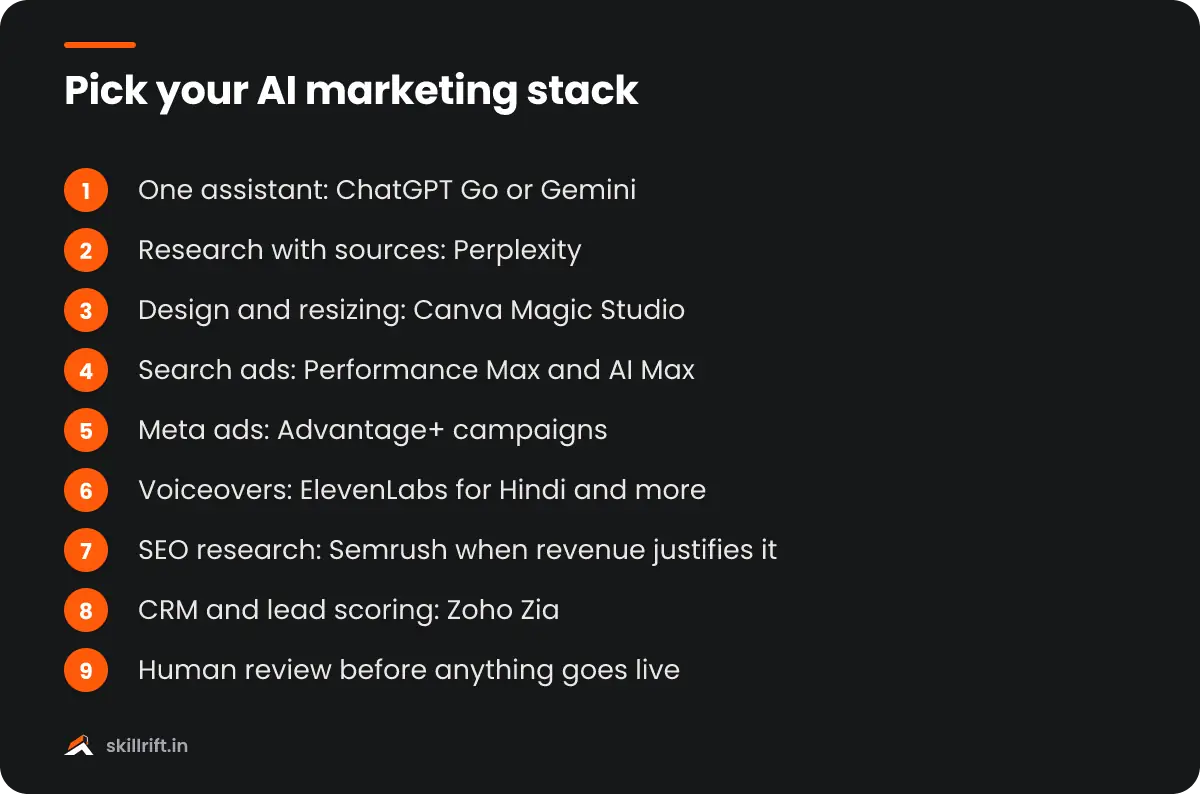
A small Indian marketing team can run a solid AI stack for roughly ₹1,000 to ₹3,000 a month by combining one paid assistant, Canva Pro and the free AI built into ad platforms.
- Pick one assistant. ChatGPT Go at ₹399 or Gemini if you already pay for Google Workspace. Do not pay for three assistants that do the same job.
- Add design. Canva Pro covers most day-to-day creative needs for social and performance ads.
- Use platform AI before third-party tools. Performance Max, AI Max and Advantage+ are already in your accounts.
- Write a brand prompt document. One page with your tone, banned words, audience and product facts. Paste it into every new chat.
- Review every output. AI gets prices, offers and claims wrong. A human must check anything that goes live.
- Measure time saved. Track how long a carousel, a blog brief or a weekly report took before and after. Drop any tool that does not save real hours.
If you want a broader view of where AI fits across SEO, ads, email and analytics, read our complete guide to using AI for marketing.
Mistakes to avoid with AI tools for marketing
The biggest mistake is publishing AI output without editing it. The second is pasting confidential client data into tools whose data settings you have never checked.
- Generic copy. If your prompt is vague, the output will sound like every other brand. Feed in real customer reviews and objections.
- Invented facts. Assistants still make up statistics and quotes. Verify every number against the original source.
- Data privacy. Turn off training on your chats where the setting exists, and use business plans for client work. Remember India’s DPDP Act when handling customer data.
- Tool hoarding. Five unused subscriptions cost more than one tool your team actually knows well.
- Blind trust in automation. Platform AI optimises for the goal you set. If you track the wrong conversion, it will efficiently buy the wrong results.
Next steps: choosing AI tools for marketing that fit your work
The right AI tools for marketing are the ones your team uses every day for a clear job, not the longest list of subscriptions. Start this week with one assistant, Canva and the AI already inside Google Ads and Meta. Build a brand prompt document, run one workflow end to end, and measure the hours saved before adding anything else.
If you want structured, hands-on practice with these tools on real campaigns, the SkillRift AI marketing course covers prompts, workflows and platform AI step by step, or you can start with the free masterclass.
Frequently asked questions
What are the best free AI tools for marketing?
The free tiers of ChatGPT, Gemini, Claude and Perplexity cover writing and research, Canva’s free plan handles basic design, and Google Ads and Meta Advantage+ include their AI features at no extra cost. Together they let a beginner or small business run real campaigns without paying for any software.
Which AI tool is best for social media marketing?
For most Indian brands, Canva Magic Studio plus one assistant such as ChatGPT is the most practical pair. Canva handles visuals, resizing and brand consistency, while the assistant drafts captions, hooks and content calendars. Add ElevenLabs if you produce reels with voiceovers in Hindi or regional languages.
Can AI replace a digital marketer?
No. AI speeds up drafting, design, research and reporting, but it cannot set strategy, understand a specific customer deeply or take responsibility for results. Marketers who use AI well are replacing those who do not, which is why employers in Bengaluru, Delhi and Pune increasingly list AI skills in job descriptions.
Is ChatGPT Go enough for marketing work?
For most solo marketers and small teams, yes. At ₹399 a month, ChatGPT Go handles copywriting, content outlines, email drafts and basic analysis well. Upgrade to Plus at ₹1,999 only if you regularly hit usage limits or need its deeper reasoning, advanced image generation and custom GPT features.
Are AI-generated ads allowed on Google and Meta?
Yes. Both platforms offer their own generative tools for ad text and images. Your ads must still follow normal advertising policies, so avoid misleading claims, fake testimonials and unrealistic before-and-after results. Meta may also require disclosure for AI-altered content in political or social issue ads.