Top 26 GA4 Interview Questions and Answers (2026)
26 GA4 interview questions with model answers, from event basics to attribution and live troubleshooting scenarios, plus a one-week prep plan.


The GA4 interview questions you will face in 2026 test three things: whether you understand the event-based data model, whether you can configure a property correctly, and whether you can turn reports into decisions. This guide covers 26 real questions with model answers, grouped from basics to scenario rounds, so you can prepare in a weekend.
I have sat on both sides of these interviews for analytics and performance marketing roles. Most candidates do not fail on definitions. They fail when the interviewer asks “what would you do next?” So every answer below gives you the concept and the practical angle a hiring manager wants to hear.
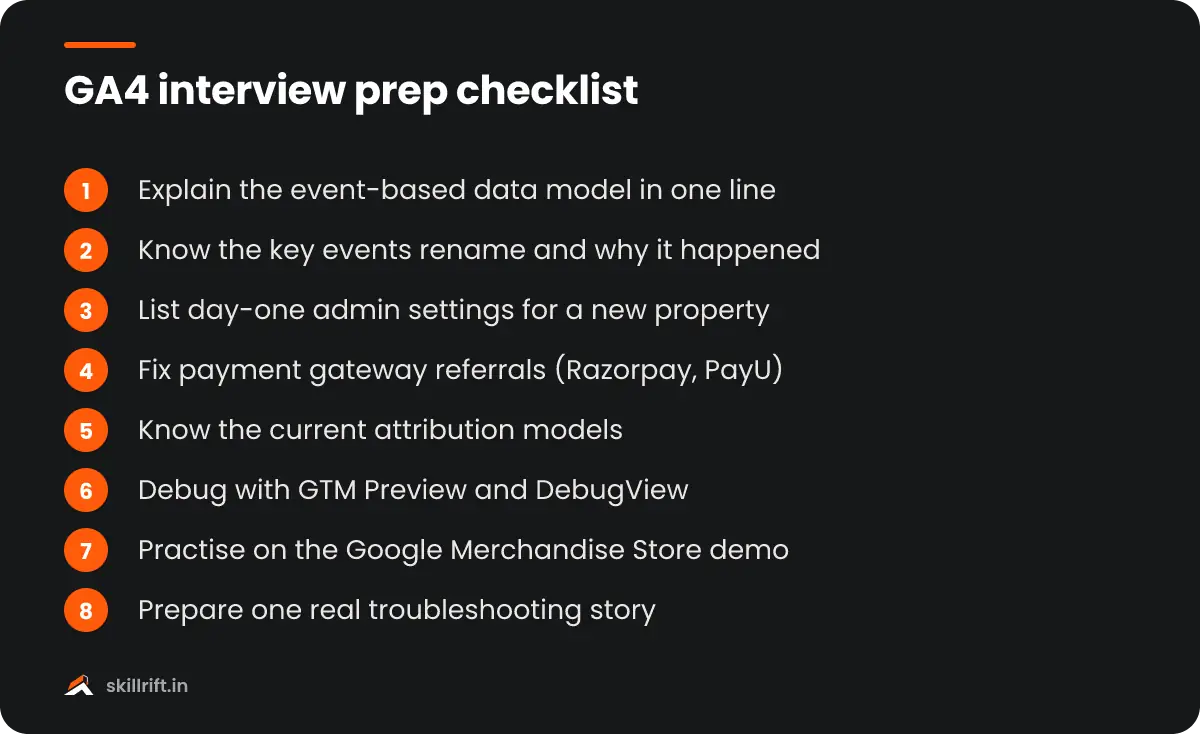
How GA4 interview questions are structured in 2026
Most GA4 interview questions follow a fixed ladder: fundamentals, setup and configuration, reports and explorations, attribution and integrations, then a live scenario. Freshers usually stop at the first two levels. Candidates with two or more years of experience are pushed to the last two.
Agencies in Bengaluru, Gurugram and Pune often add a short practical test: they share a demo property and ask you to find why conversions dropped. D2C brands care more about ecommerce tracking and purchase attribution. Use the table below to decide where to spend your preparation time.
| Role | Typical experience | Focus areas | Indicative salary (India) |
|---|---|---|---|
| Digital marketing executive | 0–2 years | Basics, key events, standard reports | ₹3–6 lakh per year |
| Performance marketing analyst | 1–4 years | Attribution, Google Ads linking, UTMs | ₹6–12 lakh per year |
| Web / digital analyst | 2–6 years | Explorations, GTM, data layer, BigQuery | ₹8–16 lakh per year |
| Analytics lead | 7+ years | Measurement plans, governance, consent | ₹15–25 lakh per year |
Salary bands are indicative, based on 2026 job postings and salary aggregators such as Flexiple; actual offers vary by city and company. Metro roles typically pay more than tier-2 roles.
GA4 interview questions on fundamentals
Fundamental GA4 interview questions check whether you think in events instead of the old Universal Analytics hit types. Get these crisp; they set the tone for the rest of the round.
1. What is Google Analytics 4 and how is it different from Universal Analytics?
GA4 is Google’s current analytics platform. It measures websites and apps in one property using an event-based model, where every interaction, including a page view, is an event with parameters. Universal Analytics used sessions and hit types such as pageview, event and transaction. Universal Analytics stopped processing data in July 2023, so every property you manage today is GA4.
What interviewers look for: the phrase “event-based model” and an understanding that UA is fully retired.
2. What is an event in GA4?
An event is any user interaction or occurrence you record, such as page_view, scroll, add_to_cart or purchase. Each event can carry parameters that add context, for example page_location, value or currency. GA4 groups events into automatically collected events, enhanced measurement events, recommended events and custom events.
What interviewers look for: naming all four types and giving one real example of each.
3. What are parameters, and what is the difference between event-scoped and user-scoped dimensions?
Parameters are extra details sent with an event. To report on a custom parameter you register it as a custom dimension or metric. Event-scoped dimensions describe a single action, such as the form name. User-scoped dimensions describe the person across sessions, such as membership tier or city cluster.
What interviewers look for: knowing that unregistered parameters are not visible in standard reports.
4. What is a key event?
A key event is an event you mark as important to the business, such as generate_lead or purchase. Google renamed “conversions” to “key events” in GA4 in 2024 so the term would not clash with Google Ads. When you import a key event into Google Ads, it becomes a conversion there.
What interviewers look for: the rename, and why the same action can show different numbers in GA4 and Google Ads.
5. What is an engaged session and how is engagement rate calculated?
An engaged session lasts longer than 10 seconds, includes a key event, or has at least two page or screen views. Engagement rate is engaged sessions divided by total sessions. Bounce rate in GA4 is simply the opposite: the share of sessions that were not engaged.
What interviewers look for: the three conditions, and that bounce rate means something different from UA.
6. What is the difference between users, active users and new users?
Total users counts unique users who logged any event. Active users counts users who had an engaged session or met other engagement conditions, and it is the default “Users” metric in most GA4 reports. New users counts people interacting with your site for the first time, based on the first_visit or first_open event.
What interviewers look for: knowing that “Users” in reports usually means active users.
7. What does enhanced measurement track?
Enhanced measurement automatically records page views, scrolls (when a user reaches 90% of the page), outbound clicks, site search, form interactions, embedded YouTube video engagement and file downloads, without extra code. You can switch each one on or off inside the web data stream settings.
What interviewers look for: a practical caveat, such as form interaction tracking being unreliable on some custom forms.
GA4 interview questions on setup and configuration
Setup questions reveal whether you have actually touched a live property. Mention admin paths and real mistakes you have fixed; that is what separates practitioners from course-only candidates.
8. Explain the account, property and data stream hierarchy.
An account sits at the top, usually one per business. Under it you create properties, each with its own reports and settings. Each property has data streams: one web stream per website and separate streams for iOS and Android apps. The measurement ID (starting with G-) belongs to a web data stream.
What interviewers look for: when you would create a separate property versus a separate stream.
9. What should you change in a new GA4 property on day one?
Set data retention to 14 months instead of the default 2 months, define internal traffic and activate the filter, add payment gateways such as Razorpay or PayU to the unwanted referrals list, confirm the time zone and currency (Asia/Kolkata and INR for most Indian brands), and link Google Ads and Search Console.
What interviewers look for: a checklist mindset, and knowing that the retention setting affects explorations and funnel reports, not standard reports (see Google’s data retention help page).
10. Why do payment gateways appear as referral sources, and how do you fix it?
When a customer leaves for a payment page and returns to the thank-you page, GA4 can start a new session credited to the gateway domain. This hides the real source, such as a Meta ad. Add domains like razorpay.com or payu.in under “List unwanted referrals” in the tag settings of the web stream.
What interviewers look for: this is a very common Indian ecommerce question; a confident answer earns quick credit.
11. How do you set up cross-domain tracking?
In the web stream’s tag settings, open “Configure your domains” and add every domain that belongs to the same user journey, for example a main site and a separate booking domain. GA4 then adds a linker parameter to links between them so the session continues. Both domains must use the same measurement ID.
What interviewers look for: testing it by checking for the _gl parameter in the URL.
12. When would you use Google Tag Manager instead of the gtag.js snippet?
Use Google Tag Manager when you need custom events, multiple marketing tags or frequent changes without developer releases. A direct gtag.js snippet is fine for a simple site that only needs enhanced measurement. Most agencies standardise on GTM because it gives version control, preview mode and cleaner handover between teams.
What interviewers look for: a reason, not just “GTM is better”.
13. How do you track a purchase correctly?
Send the recommended purchase event with transaction_id, value, currency and an items array, ideally pushed through the data layer on the order confirmation page. The transaction_id prevents duplicate counting when users refresh the page. On Shopify or WooCommerce, an official integration or a well-tested plugin is usually safer than a hand-built tag.
What interviewers look for: mentioning transaction_id deduplication and the INR currency code.
14. How do you debug GA4 tracking?
Use GTM Preview mode with Tag Assistant to see which tags fire, then open DebugView in GA4 to watch events and parameters arrive in real time. For quick checks, the Realtime report confirms that data is flowing. Standard reports can take 24 to 48 hours to fully process, so never judge a new setup from them.
What interviewers look for: a clear, ordered debugging process.
GA4 interview questions on reports and explorations
This round tests whether you can find answers quickly. Interviewers often share a screen and ask you to navigate, so practise in the free Google Merchandise Store demo account before the interview.
15. What is the difference between standard reports and explorations?
Standard reports are pre-built summaries in the Reports section, such as Traffic acquisition and Pages and screens. Explorations are flexible analysis tools where you build free-form tables, funnels, path analysis, segment overlaps and cohort views. Explorations use event-level data, so they are bounded by the data retention setting.
What interviewers look for: picking the right tool for a given business question.
16. What is the difference between User acquisition and Traffic acquisition?
User acquisition shows the first source that brought each new user, using first user dimensions. Traffic acquisition shows the source of every session, using session dimensions. If a user first came from organic search and later returned through an email, both reports tell different but correct stories.
What interviewers look for: correct use of “first user” versus “session” scope.
17. What is data thresholding?
GA4 may withhold rows in a report when the user count is small and Google signals or demographic data could make individuals identifiable. You see a warning icon in the report. Switching reporting identity to device-based, or widening the date range, usually reduces thresholding.
What interviewers look for: linking thresholding to privacy and reporting identity.
18. What are reporting identities in GA4?
GA4 offers Blended, Observed and Device-based identities. Blended uses user ID, device ID and modelled data. Observed uses user ID and device ID without modelling. Device-based relies only on the device identifier. The choice changes how users are counted across devices but never changes the raw data collected.
What interviewers look for: knowing the setting is reversible.
19. How would you build a checkout funnel?
Create a funnel exploration with steps such as view_item, add_to_cart, begin_checkout and purchase. Choose open or closed funnel, add a breakdown by device category, and compare segments like new versus returning users. The biggest drop-off between two steps tells you where to focus.
What interviewers look for: turning the funnel into one concrete recommendation.
GA4 interview questions on attribution and privacy
Attribution and integration GA4 interview questions are where performance marketing candidates are filtered. Expect follow-ups on why GA4 and ad platforms report different numbers.
20. Which attribution models are available in GA4 now?
GA4 offers data-driven attribution, paid and organic last click, and Google paid channels last click. Google retired first click, linear, time decay and position-based models in 2023. Data-driven attribution distributes credit across touchpoints using the property’s own conversion paths.
What interviewers look for: being up to date on the retired models.
21. Why do GA4 and Meta Ads show different purchase numbers?
The two tools use different attribution logic and windows. Meta counts view-through and click-through conversions inside its own ecosystem, while GA4 attributes using its chosen model across all channels. Consent choices, ad blockers and cross-device journeys also affect each tool differently. Use each platform for in-channel optimisation and GA4 for cross-channel comparison.
What interviewers look for: a calm explanation, not “one of them is wrong”.
22. Why should you link GA4 with Google Ads and Search Console?
Linking Google Ads lets you import key events as conversions, build audiences for remarketing and see cost data in GA4. Linking Search Console adds organic query and landing page reports. Both links give a fuller view of paid and organic performance without exporting data manually.
What interviewers look for: mentioning audience sharing as a practical benefit.
23. What is the BigQuery export and when is it useful?
GA4 can export raw, event-level data to BigQuery, which is available even on free properties. It is useful when you need data beyond the retention window, want to join GA4 data with CRM or offline sales, or need SQL-level analysis. Standard properties have a daily export limit, so high-traffic sites may need the streaming option.
What interviewers look for: a real use case such as joining with CRM data.
24. What is Consent Mode, and does it matter in India?
Consent Mode lets Google tags adjust behaviour based on a user’s cookie choice, and lets GA4 model some missing data. It is mandatory for ad features in the EEA and UK. In India, the Digital Personal Data Protection Rules were notified in November 2025 with phased compliance, so brands increasingly use consent banners too.
What interviewers look for: awareness of the DPDP framework, without claiming legal expertise.
Scenario-based GA4 interview questions
Scenario-based GA4 interview questions decide most offers. Answer with a structure: check tracking, check data, then check the business.
25. Purchases in GA4 dropped by 40% overnight. What do you do?
First check if the purchase tag still fires using DebugView and a test order. Then check recent website releases, consent banner changes and GTM version history. Compare against the backend order count in Shopify or the CRM. If backend orders also fell, the problem is business-side, so look at traffic sources, stock and payment failures.
What interviewers look for: separating a tracking problem from a real sales problem.
26. A Pune-based coaching institute wants to know which channel brings the best leads. How do you set it up?
Track form submissions as a generate_lead key event, tag every campaign with consistent UTM parameters, and pass a lead quality signal from the CRM back to GA4 or Google Ads where possible. Then compare channels in the Traffic acquisition report and a free-form exploration by session source, cost per lead and qualified lead rate.
What interviewers look for: going beyond lead volume to lead quality.
How to prepare for GA4 interview questions in one week
The fastest way to prepare is to practise on a real property rather than memorising definitions. Here is a simple seven-day plan that works for freshers and working marketers.
- Day 1–2: Open the Google Merchandise Store demo account and explore every standard report.
- Day 3: Set up GA4 on a free WordPress or Blogger site and add GTM.
- Day 4: Create two custom events and mark one as a key event.
- Day 5: Build a funnel and a path exploration; write one insight from each.
- Day 6: Revise attribution, consent and integrations from the official GA4 events documentation.
- Day 7: Do a mock interview using the 26 GA4 interview questions above, answering aloud in under 90 seconds each.
If you are applying to broader marketing roles, combine this with our list of digital marketing interview questions and answers. For a deeper foundation in measurement, read the beginner’s guide to learning marketing analytics.
Conclusion and next steps
Clearing GA4 interview questions is less about memorising and more about showing you have worked inside a property. Build a small demo setup, keep a list of the mistakes you fixed, and practise explaining one insight from data in plain language. That combination stands out in almost every analytics round.
Your next steps: set up a test property this week, revise the scenario questions twice, and prepare one story about a tracking issue you solved. If you want structured, hands-on practice with real properties and mentor feedback, the SkillRift Google Analytics 4 course covers everything in this guide, or you can start with our free masterclass.
Frequently asked questions
Are GA4 interview questions asked for freshers?
Yes. Most entry-level digital marketing roles in India now include a few GA4 interview questions on events, key events, engagement rate and standard reports. Freshers are rarely tested on BigQuery or attribution, but they are expected to navigate the interface confidently and explain what a basic report shows.
Is the Google Analytics certification enough to get a job?
The free Google Analytics certification from Skillshop shows you understand the basics, but it is rarely enough on its own. Recruiters value hands-on work more: a property you set up, custom events you created and one insight you drew from data. Pair the certificate with a small portfolio project.
How long does it take to learn GA4 for interviews?
With daily practice of one to two hours, most marketers can learn enough GA4 for an entry-level interview in two to three weeks. Analyst roles that need GTM, the data layer and explorations typically take two to three months of regular hands-on work with a live or demo property.
Do I need to know Google Tag Manager for a GA4 role?
For analyst and performance marketing roles, yes. Most companies implement GA4 through Google Tag Manager, so interviewers expect you to explain triggers, variables, tags and Preview mode. For general marketing executive roles, a basic understanding is usually enough, but it still helps you stand out.
What salary can a GA4 analyst expect in India?
Salaries vary by city and experience. Based on 2026 job postings and salary aggregators, entry-level analytics roles typically pay ₹4–8 lakh a year, mid-level web analysts ₹8–16 lakh, and analytics leads with seven or more years can earn ₹15–25 lakh or more in metros such as Bengaluru.