Top 30 Performance Marketing Interview Questions and Answers (2026)
30 performance marketing interview questions with model answers on ROAS maths, Google Ads, Meta Ads, attribution and live scenarios, plus 2026 salary ranges in India.

The performance marketing interview questions asked in India in 2026 cover five areas: core metrics like ROAS and CAC, Google Ads, Meta Ads, tracking and attribution, and live scenarios such as a sudden drop in results. Below are 30 questions with model answers, plus what the interviewer is really testing in each one.
I have hired for paid media roles at a Bengaluru D2C brand and a Delhi agency. The logic behind performance marketing interview questions rarely changes: interviewers want to see that you think in unit economics, read data before touching settings, and can explain a decision to a founder in two sentences.
If the role is mainly search, pair this list with our Google Ads interview questions and answers. For social-heavy roles, read the Meta Ads interview guide as well.
Performance marketing interview questions on metrics and fundamentals
Every round starts with numbers, because a performance marketer who cannot do margin maths will scale a loss-making campaign. Expect these first.
1. What is performance marketing, and how is it different from brand marketing?
Performance marketing is paid advertising where every rupee is tied to a measurable action: a sale, a lead, an install. You optimise towards that outcome and judge success by cost per result and return. Brand marketing builds awareness and memory over a longer period, and its results are harder to attribute to a single ad.
What interviewers look for: That you see the two as complementary, not rivals. Strong brand demand makes performance campaigns cheaper.
2. How do you calculate ROAS, and how is it different from ROI?
ROAS is revenue from ads divided by ad spend. Spend ₹50,000 and generate ₹2,00,000 in attributed sales and your ROAS is 4. ROI subtracts all costs (product, shipping, payment fees, the ads themselves) and divides profit by investment. A campaign can show 4x ROAS and still lose money if margins are thin.
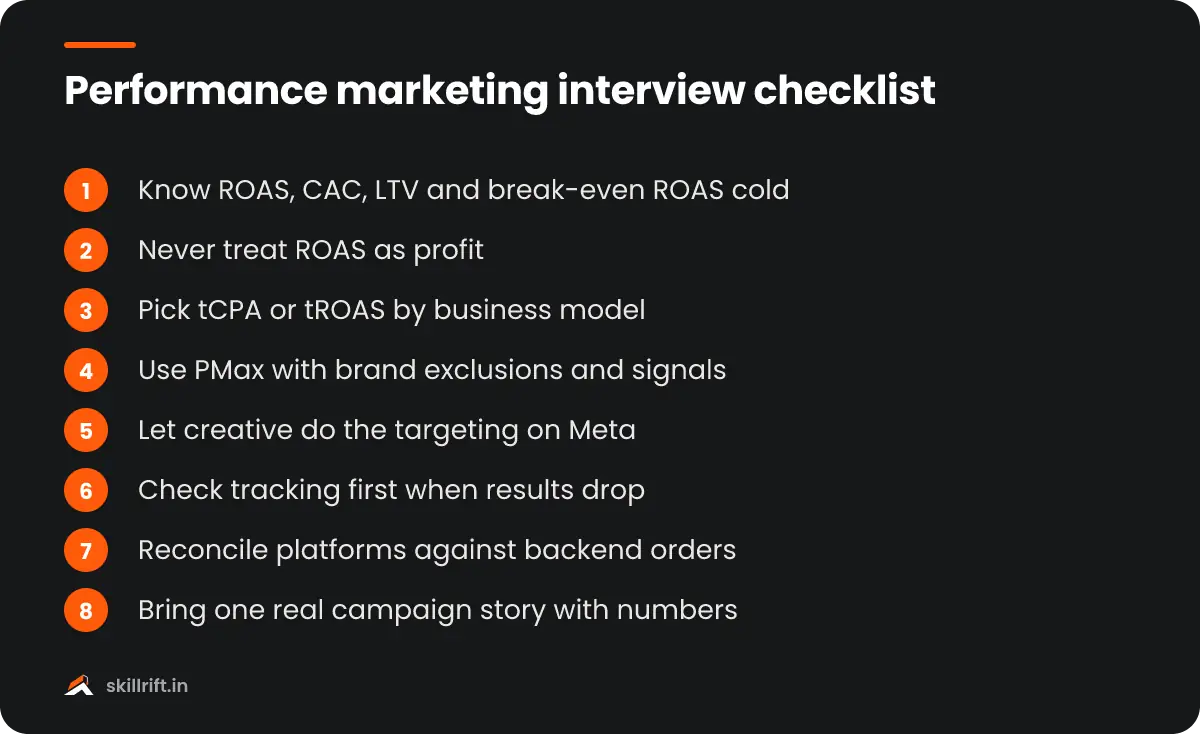
What interviewers look for: That you never treat ROAS as profit.
3. What is break-even ROAS?
Break-even ROAS is the return at which ad spend exactly equals the contribution margin earned. The formula is 1 divided by contribution margin. If a product keeps 40% of its selling price after product cost, shipping and fees, the break-even ROAS is 2.5. Below that, every sale loses money before overheads.
What interviewers look for: Whether you set targets from the business’s margins instead of copying a “good ROAS” number from a blog.
4. Explain CAC and LTV, and why the ratio matters.
CAC is the total cost of acquiring one new customer, usually marketing spend divided by new customers in a period. LTV is the gross margin a customer brings over their relationship with you. A common rule of thumb is an LTV to CAC ratio of about 3:1. In repeat categories like coffee, a healthy LTV can justify a first-order loss.
What interviewers look for: Understanding that first-order ROAS is not the whole story for subscription and repeat businesses.
5. What is the difference between CPA, CPL and CPM?
CPA is cost per acquisition, usually a purchase or sign-up. CPL is cost per lead, common in real estate, education and B2B. CPM is cost per thousand impressions, the price of reach. CPM shows auction cost; CPA shows whether the funnel converts.
What interviewers look for: That you can explain how a rise in CPM flows down to CPA.
6. What is MER, and why do some brands track it over platform ROAS?
MER, or marketing efficiency ratio, is total revenue divided by total marketing spend across every channel. Platforms each claim credit for the same sale, so adding up Google and Meta ROAS often overstates reality. MER is a blunt but honest check on whether marketing as a whole is paying back.
What interviewers look for: Awareness of double counting across platforms.
7. Walk me through a full-funnel paid strategy for a new D2C brand.
I would start with Google Search on brand and high-intent category terms, and Meta prospecting with broad targeting and several creative angles. Next comes retargeting for site visitors and cart abandoners, then YouTube or Reels for reach once the funnel converts. Budget follows evidence: start with most of it on prospecting, then adjust as blended CAC settles.
What interviewers look for: Structure, a clear first step, and a budget logic rather than a list of channels.
Free playbook
Get the free Career and Interview Kit
A 25-page guide covering roles, a learning roadmap, portfolio projects, resume and LinkedIn templates, 55+ interview questions with answers and case assignments. We email it to you, plus occasional new guides. Unsubscribe anytime.
Google Ads questions
Google Ads makes up a big share of performance marketing interview questions. These test whether you understand intent, automation and where Smart Bidding needs your help.
8. How does the Google Ads auction decide which ad shows?
Google calculates Ad Rank for each eligible ad using your bid, ad quality (expected CTR, ad relevance, landing page experience), the context of the search and the expected impact of assets. Higher Ad Rank wins better positions. You rarely pay your full bid, because the actual cost depends on the competition below you.
What interviewers look for: That you know a good Quality Score can beat a bigger budget.
9. When would you use Target CPA versus Target ROAS?
Target CPA suits businesses where every conversion is worth roughly the same, like a lead form for a Pune coaching institute. Target ROAS suits e-commerce where order values vary, so the system can bid more for a ₹4,000 basket than a ₹400 one. Both need reliable conversion tracking and enough volume to learn.
What interviewers look for: That you choose by business model and conversion value, not by habit.
10. How do you set a Target ROAS for a new campaign?
I start close to the campaign’s actual conversion value per cost over the last few weeks, not at the dream number. Setting a target far above history chokes delivery. Once volume is stable, I raise it 10 to 15% at a time and wait out the learning period. Google’s own Target ROAS documentation recommends basing it on historical data too.
What interviewers look for: Patience with Smart Bidding and small, measured changes.
11. What is Performance Max, and what are its risks?
Performance Max is a goal-based campaign type that runs across Search, Shopping, YouTube, Display, Discover, Gmail and Maps from one budget. Its main risk is that it can lean on brand searches and retargeting, which inflates results. I add brand exclusions, feed it first-party audience signals, and check the channel performance report Google added in 2025 to see where spend goes.
What interviewers look for: That you use PMax with guardrails, not blind trust.
12. How do you structure Search campaigns in 2026?
Fewer, larger campaigns grouped by business goal and margin, not dozens of single-keyword ad groups. I keep brand and non-brand separate, use phrase and broad match with Smart Bidding once tracking is reliable, and lean on the search terms report plus negative keyword lists to control quality.
What interviewers look for: Knowing that consolidation helps automation learn faster.
13. What would you check if Search CPCs suddenly rose 40%?
First, the auction insights report for a new competitor or a rival raising bids. Then any recent bid strategy or target change, a Quality Score drop after a landing page update, and seasonality, since CPCs climb before Diwali and big sale events.
What interviewers look for: An ordered diagnosis, not a panicked bid cut.
Meta Ads questions
On the Meta side, performance marketing interview questions focus on creative, broad targeting and how automation decides who sees your ads.
14. Why do many advertisers use broad targeting on Meta now?
Meta’s delivery system has become good at finding buyers from signals in the creative and conversion data. Narrow interest stacks often limit learning and raise CPMs. With Advantage+ audience, you give suggestions and Meta can go beyond them.
What interviewers look for: That you understand why creative variety matters more than audience hacks.
15. What are Advantage+ sales campaigns?
Advantage+ sales campaigns, earlier called Advantage+ shopping campaigns, automate audience, placement and budget for conversion goals. You supply creatives, a budget and a conversion event. They work best for brands with steady purchase volume and a broad catalogue. I still test them against a manual campaign before moving the full budget.
What interviewers look for: A balanced view and a willingness to test.
16. How do you test creatives on Meta?
I test one variable at a time: hook, format or offer. Each concept gets enough spend to reach a meaningful number of conversions, often a budget equal to two or three times the target CPA, before I decide. Winners move into the scaling campaign. Thumb-stop rate, hold rate and CTR show where a weak ad loses people.
What interviewers look for: A repeatable system and a sense of statistical patience.
17. What is creative fatigue, and how do you spot it?
Creative fatigue is when the same audience has seen an ad too often and it stops working. Signs are rising frequency, falling CTR and climbing CPA on an ad that used to win. The fix is a pipeline of new angles, not new colours on the same video.
What interviewers look for: Proactive creative planning rather than reacting after results crash.
18. How would you scale a winning Meta campaign?
Increase budget gradually, about 20% every few days, so delivery stays stable. Alternatively, duplicate the winning ads into a fresh campaign with a higher budget. Watch CPA as spend rises; some rise is normal because you reach less eager buyers. Stop scaling when marginal CPA crosses your break-even point.
What interviewers look for: Thinking in marginal returns, not average ones.
Tracking, attribution and measurement questions
These performance marketing interview questions separate people who trust dashboards from people who check them.
19. What is the Meta Conversions API, and why use it?
The Conversions API sends conversion events from your server to Meta, alongside the browser pixel. It recovers events lost to ad blockers, browser restrictions and iOS privacy changes. Events from both sources should share an event ID so Meta can deduplicate them.
What interviewers look for: Knowing deduplication, not just the name.
20. What are enhanced conversions in Google Ads?
Enhanced conversions send hashed first-party data, like email or phone number, with a conversion so Google can match it to signed-in users. That improves measurement where cookies fail. For lead generation, enhanced conversions for leads also help you import offline outcomes, such as a lead becoming a paid admission.
What interviewers look for: Experience setting it up through Google Tag Manager or the Google tag.
21. Explain attribution windows and models.
An attribution window is how long after a click or view a conversion still counts for an ad. Meta’s common default is 7-day click and 1-day view. Google Ads uses data-driven attribution by default for most conversion actions. Different windows produce different ROAS, so compare platforms only with matching settings.
What interviewers look for: That you know why GA4 and Ads Manager never agree.
22. Why does GA4 show fewer conversions than Meta?
Meta counts view-through conversions and credits any purchase within its window, even if the user later came via Google. GA4 uses its own attribution and often loses data to consent and blockers. I reconcile against actual orders in the backend.
What interviewers look for: A calm, method-driven answer and use of the order database as ground truth.
23. How would you measure incrementality?
Incrementality asks how many sales would not have happened without the ads. Methods include geo holdout tests (pause ads in a few cities and compare), Meta’s conversion lift studies, and Google’s lift measurement where available. Meta has also introduced an incremental attribution setting for eligible accounts.
What interviewers look for: Willingness to question platform-reported numbers.
Scenario-based performance marketing interview questions
Scenarios are where most candidates are decided. Talk through your thinking aloud and state your assumptions.
24. ROAS dropped from 4 to 2.5 overnight. What do you do?
First, check whether it is a tracking problem: did purchases in the backend actually fall, or did the pixel break after a site update? If sales fell, I check spend changes, CPM, CTR and conversion rate to find which stage moved. Then I rule out stock-outs, price changes, payment gateway issues or a competitor sale before touching campaigns.
What interviewers look for: Checking data quality first and diagnosing the funnel in order.
25. A founder wants to double spend next month. How do you respond?
I would agree to test it in stages, not in one jump. I would show how marginal CPA has changed at recent spend levels and what CAC we can afford. Then I would propose raising spend by 25 to 30% each week with a stop rule if blended CAC crosses the break-even line.
What interviewers look for: Commercial maturity and the ability to push back with data.
26. You have ₹1 lakh a month for a new Bengaluru clinic. How would you split it?
Most of it, roughly 60 to 70%, would go to Google Search for high-intent local terms like “dermatologist near me”. I would also set up Google Business Profile and call tracking. The rest goes to Meta lead ads targeting a radius around the clinic, with a WhatsApp follow-up flow. I would judge it on cost per booked appointment, not cost per lead.
What interviewers look for: Matching channels to intent and measuring outcomes that the client actually cares about.
27. COD orders have a high return rate. How does that change your targets?
Return-to-origin orders cost shipping both ways and earn nothing. I would calculate ROAS on delivered revenue, not placed orders, and raise the target to match. Then I would test prepaid discounts, verify COD orders via WhatsApp, and send the delivered-order signal back to the platforms where possible.
What interviewers look for: India-specific e-commerce awareness.
28. Which channels would you add beyond Google and Meta?
It depends on the category. Amazon Ads is essential if the brand sells on marketplaces, and quick commerce ads on Blinkit, Zepto and Instamart matter for grocery, beauty and snacks in metros. B2B brands should look at LinkedIn. I add a channel only when tracking and a clear success metric are in place.
What interviewers look for: Breadth with discipline.
29. How do you report results to a non-marketing founder?
One page: spend, revenue, blended CAC or MER, and how it compares with last month and the target. Then three lines on what worked, what did not, and what I will change.
What interviewers look for: Clear communication and ownership.
30. Tell me about a campaign that failed.
Pick a real one. Explain the hypothesis, what you spent, the metric that told you it failed, and what you changed. For example, a carousel offer that drove cheap clicks but poor add-to-cart rates, which taught you to judge creatives on downstream metrics.
What interviewers look for: Honesty and learning, not a disguised success story.
Performance marketing salaries in India in 2026
Salary talk usually follows the performance marketing interview questions, so know your number. Pay depends on city, experience and budget managed. The ranges below are typical figures from salary sites and job postings in 2026; individual offers vary.
| Role | Experience | Typical annual CTC |
|---|---|---|
| Performance marketing executive | 0–2 years | ₹3–6 lakh |
| Performance marketing specialist | 2–4 years | ₹6–12 lakh |
| Performance marketing manager | 4–7 years | ₹12–20 lakh |
| Head of growth or paid media lead | 8+ years | ₹25–40 lakh and above |
Bengaluru, Gurugram and Mumbai usually pay at the top of these ranges. Agencies often pay less but expose you to many accounts quickly.
How to prepare for performance marketing interview questions
The best preparation is hands-on proof, not memorised answers. Here is what I would do in the two weeks before an interview.
- Build a margin sheet for one real product and calculate its break-even ROAS and allowable CAC.
- Run a small campaign with your own ₹5,000 to ₹10,000, even for a friend’s business, and document the results.
- Earn the free Google Ads certifications and go through Meta Blueprint’s free courses.
- Prepare two stories: one campaign you scaled and one that failed.
- Practise the scenario questions aloud and time yourself to two minutes each.
If you want structured practice on live accounts, the SkillRift performance marketing course covers Google Ads, Meta Ads, tracking and reporting with real projects. You can also start with the free masterclass. Work through these performance marketing interview questions with real numbers and the interview becomes a conversation, not a test.
Expect questions on automation too: here is how Meta Advantage+ campaigns work and how to set them up.
Frequently asked questions
How should a fresher prepare for performance marketing interview questions?
Run one small real campaign and document it. Spend a few thousand rupees on Google or Meta for a local business or your own product, track conversions properly, and write up the results with numbers. Combine that with clear answers on ROAS, CAC and break-even maths. Practical proof beats certificates alone.
Is performance marketing a good career in India?
Yes. D2C brands, fintech, edtech, real estate and agencies all hire performance marketers because paid media is directly tied to revenue. Pay rises quickly once you have managed meaningful budgets. The trade-off is pressure: results are visible every day, so you need comfort with numbers and accountability.
Which tools should I know for a performance marketing job?
Google Ads, Meta Ads Manager, GA4 and Google Tag Manager are the core. Add Looker Studio for reporting, Google Sheets or Excel for analysis, and Shopify or your platform’s analytics. Marketplace roles add Amazon Ads. Knowing how to verify tracking matters more than knowing many tools superficially.
Do I need a certification to get a performance marketing job?
Not strictly. Free Google Ads certifications and Meta Blueprint courses help you clear resume filters, especially as a fresher. Hiring managers, though, care more about whether you have run campaigns, read data correctly and can explain your decisions. A portfolio of real results usually outweighs extra certificates.