How to Use ChatGPT for SEO Without Hurting Your Rankings
A practical workflow for using ChatGPT on keyword clustering, outlines, metadata, schema and content refreshes, while staying clear of Google's scaled content abuse rules.

Here is how to use ChatGPT for SEO safely: use it for research, keyword clustering, outlines, meta tags, schema and content refreshes, but keep a human in charge of facts, experience and final writing. Google does not penalise AI-assisted content. It penalises thin, unedited pages produced at scale to manipulate rankings.
Most ranking drops blamed on “AI content” come from the same pattern: a site publishes dozens of generic articles in a month, none of them adding anything new, and traffic falls after the next core or spam update. The tool was not the problem. The process was. This guide shows a process that saves hours without putting your site at risk.
What Google actually says about AI-generated content
Google’s position is that it rewards helpful, original content however it is produced, and treats mass-produced low-value pages as spam whether a person or a model wrote them.
In its official guidance on AI-generated content, Google says appropriate use of AI is not against its guidelines. Its spam policies define “scaled content abuse” as generating many pages mainly to manipulate rankings, and they name generative AI as one way this happens. The search quality rater guidelines also tell raters to give the lowest rating to content made with little effort, originality or editing.
So the line is clear. ChatGPT drafting a page that you then fact-check, enrich with your own experience and edit is fine. Fifty city pages with the same text and a swapped place name is not.
Free playbook
Get the free SEO Playbook
A 25-page guide covering keyword research, content, on-page and technical SEO, Core Web Vitals, local SEO in India, link building, AI search and a 90-day plan. We email it to you, plus occasional new guides. Unsubscribe anytime.
How to use ChatGPT for SEO, step by step
The safest workflow uses ChatGPT for the slow, structured parts of SEO and leaves judgement, first-hand detail and final approval to you.
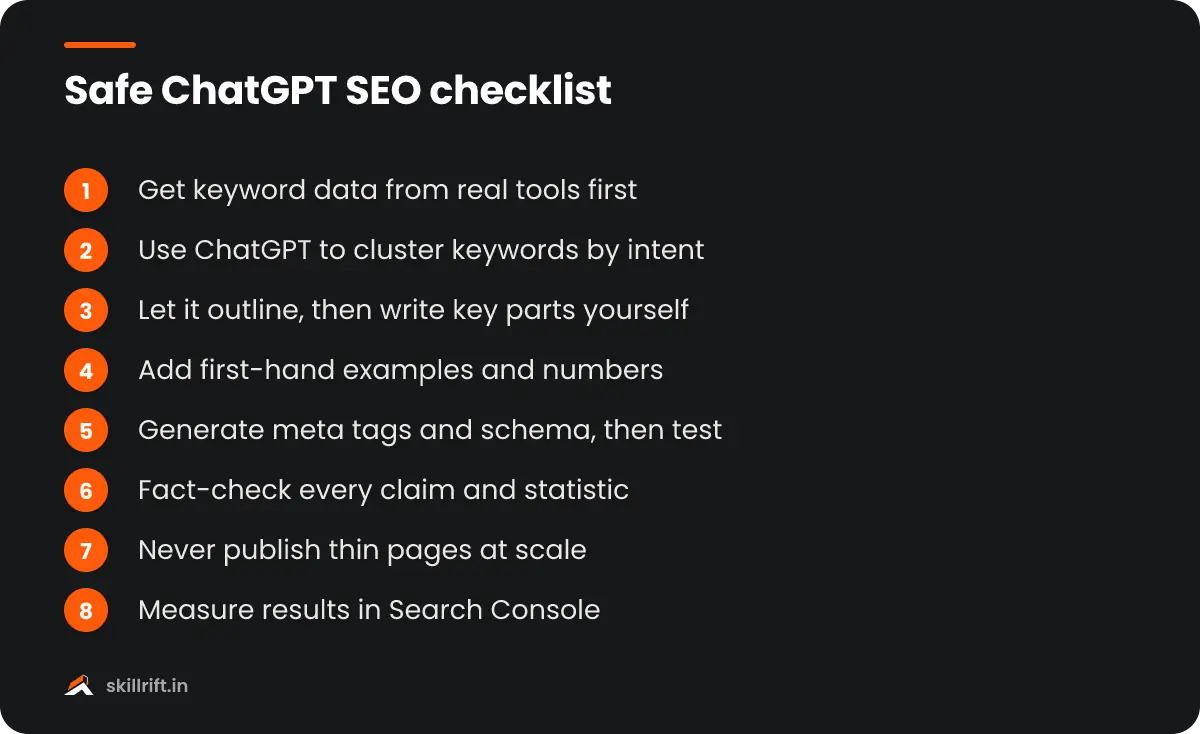
- Start with real keyword data. ChatGPT does not have reliable search volumes, so pull keywords from Google Search Console, Google Keyword Planner or a tool such as Semrush first. Our list of free keyword research methods covers the no-cost options.
- Cluster the keywords. Paste your list and ask ChatGPT to group terms by search intent and suggest one page per cluster. This stops two of your pages competing for the same query.
- Analyse intent. Paste the titles and headings of the top five ranking pages and ask what format searchers expect: a guide, a comparison, a tool, a local listing or a product page.
- Build the outline, not the article. Ask for an H2 and H3 structure that covers the topic better than the current results, including questions from Google’s “People also ask” box.
- Write the important parts yourself. Add your own examples, numbers, screenshots, client results and opinions. This is the “experience” in E-E-A-T, and it is the one thing ChatGPT cannot supply.
- Use ChatGPT to edit, not to invent. Ask it to tighten long paragraphs, suggest clearer subheadings or simplify jargon for beginners.
- Generate meta titles and descriptions. Ask for five options within 60 and 155 characters, then pick and adjust one.
- Create schema markup. ChatGPT writes FAQPage, Article, LocalBusiness and Product JSON-LD well. Test it in Google’s Rich Results Test before you publish.
- Fact-check everything. Every statistic, price, date and claim gets verified against a primary source. Delete anything you cannot confirm.
Practical ChatGPT prompts for SEO tasks
Good SEO prompts give ChatGPT context, a clear task and a format, and every output still needs a specific human check before it goes live.
| SEO task | Prompt to start with | What you must check |
|---|---|---|
| Keyword clustering | “Group these 80 keywords by search intent. Suggest one target page per group and flag overlaps.” | Groups match what Google actually ranks together |
| Content brief | “Create an outline for [keyword] for Indian beginners. Include H2s, H3s and five questions people ask.” | Covers what top results cover, plus something new |
| Meta tags | “Write five title tags under 60 characters and five descriptions under 155 for this page: [paste summary].” | Keyword included, no exaggerated claims |
| Schema | “Write FAQPage JSON-LD for these five questions and answers: [paste].” | Passes the Rich Results Test, matches visible content |
| Search Console regex | “Write a regex for Search Console that matches question queries starting with how, what, why or can.” | Test it on real query data |
| Content refresh | “Compare my article with these competitor headings and list topics I am missing.” | Gaps are relevant, not padding |
| Internal links | “Here are my 40 blog titles and URLs. Suggest five internal links for this new article with natural anchor text.” | Links make sense for a reader |
A useful habit is to paste a short “context block” at the top of every SEO chat: your site’s niche, audience, location, tone and any facts that must not change. ChatGPT’s output improves noticeably when it knows it is writing for, say, a Pune dental clinic rather than a generic dentist.
Where ChatGPT saves the most time in SEO
ChatGPT saves the most time on repetitive, structured work such as briefs, metadata, schema, technical explanations and content refreshes, rather than on writing full articles.
Refreshing old content
Updating a page that already ranks on page two is usually faster and more profitable than writing a new one. Paste the existing article and ask ChatGPT to identify outdated sections, missing subtopics and paragraphs that could be clearer. You then add current facts and examples.
Technical SEO help
ChatGPT explains crawl errors, writes robots.txt rules, drafts redirect lists and helps you understand a Core Web Vitals report. Treat it as a patient senior colleague, but test every rule on a staging site first. One wrong line in robots.txt can block your whole site.
Local SEO content
For local businesses, ChatGPT can draft Google Business Profile posts, service descriptions and review response templates. Personalise each reply with the customer’s actual feedback. Copy-paste responses to every review look careless to customers and add nothing for search.
A worked example: a Pune dental clinic blog
Here is what the workflow looks like for a real type of client, a dental clinic in Pune that wants more appointment enquiries from search.
The clinic’s Search Console shows impressions for queries like “root canal cost in Pune”, “is root canal painful” and “how long does a root canal take”, but its only page on the topic sits on page two. Instead of writing three new articles, the team decides to improve one.
- Clustering. ChatGPT groups the 30 related queries into three intents: cost, pain and recovery, and the procedure itself. All three fit one detailed page with clear sections.
- Gap analysis. Comparing the page with the top three results shows it lacks a cost table, a recovery timeline and answers about pain.
- Human input. The dentist supplies the clinic’s actual price range in rupees, explains when a crown is needed and records a short video answering the pain question.
- ChatGPT support. It tidies the dentist’s notes into readable paragraphs, writes FAQ schema and drafts three meta title options.
- Review. The dentist approves every medical statement before the update goes live.
The finished page contains things no competitor or model could invent: the clinic’s own prices, its doctor’s explanation and a real video. That is what makes the content worth ranking, and ChatGPT simply made producing it faster.
Mistakes that hurt rankings
Rankings usually drop when ChatGPT is used to replace thinking instead of support it: unedited text, made-up facts and pages published at scale.
- Publishing raw output. Unedited AI text tends to be generic, repetitive and similar to thousands of other pages. It gives Google no reason to rank you.
- Trusting its numbers. ChatGPT can confidently state search volumes, prices or statistics that are wrong. Use it for structure, not data.
- Scaling thin pages. Hundreds of near-identical location or “best X in Y” pages are exactly what the scaled content abuse policy targets.
- Removing the author. Pages with no visible author, no credentials and no first-hand detail struggle on topics involving money, health or careers.
- Fake reviews and testimonials. Never use AI to write reviews of your own business. It breaks Google’s policies and India’s consumer protection rules.
- Keyword stuffing on request. Asking ChatGPT to “add the keyword 20 times” produces awkward text that readers abandon.
We cover the editing side in more detail in our guide to AI content and SEO.
Getting found inside ChatGPT search too
SEO now includes visibility in AI answers, and the same habits that help you rank on Google, such as clear answers, accurate business details and authoritative mentions, also help ChatGPT recommend you.
ChatGPT search pulls from web sources, so pages that answer a question directly in the first paragraph, use clean headings and include specific facts are easier to quote. Local businesses should also keep their details consistent across listings. Our guide on how to get your business listed on ChatGPT walks through the steps.
Track this alongside normal SEO. Check Search Console for traffic, and every month run a few prompts your customers might use, such as “best physiotherapy clinic in Baner, Pune”, to see whether your brand appears.
Next steps: a safe plan for how to use ChatGPT for SEO
If you are deciding how to use ChatGPT for SEO on your own site, start small. Pick three existing articles that rank on page two, use ChatGPT to find gaps and improve structure, add your own experience and verified facts, then measure the change in Search Console over four to six weeks. Once that workflow works, apply it to new content.
If you want to practise these workflows with guidance, the SkillRift AI marketing course covers AI for SEO, content and ads with hands-on projects, and the free masterclass is a good place to start.
To get your pages quoted in Google’s AI answers, read what AI Overviews SEO is and how to get cited.
Frequently asked questions
Does Google penalise content written with ChatGPT?
No. Google says it ranks content on quality and helpfulness, not on how it was produced. What it penalises is scaled content abuse: many low-value pages created mainly to manipulate rankings. ChatGPT-assisted articles that are fact-checked, edited and enriched with real experience can rank as well as fully human-written ones.
How to use ChatGPT for SEO keyword research?
Use it to expand and organise keywords, not to measure them. Pull real keywords from Search Console or Keyword Planner, then ask ChatGPT to suggest related questions, group terms by intent and map each group to one page. Never trust search volumes or difficulty scores that ChatGPT produces on its own.
Can ChatGPT write a full SEO blog post?
It can produce a full draft, but publishing that draft as it is rarely works. Raw output tends to be generic and may contain wrong facts. Use ChatGPT for the outline and rough sections, then rewrite with your own examples, verified numbers and opinions so the page offers something competing results do not.
Is ChatGPT Go enough for SEO work?
For most freelancers and small businesses, yes. ChatGPT Go at ₹399 a month handles outlines, metadata, schema, regex and content refreshes comfortably. You will still need real data from Google Search Console and a keyword tool, because ChatGPT cannot see your rankings, traffic or accurate search volumes.
How do I check if my AI-assisted content is good enough to rank?
Compare it honestly with the top three results. It should answer the query faster, include specific examples or data they lack, show who wrote it and why they are credible, and contain no unverified claims. If you would not share it with a client as your own work, it is not ready.