How to Build a LinkedIn Content Strategy for B2B Brands
A seven-step plan for B2B brands in India to build a LinkedIn content strategy: goal, buyers, pillars, voices, formats, calendar and measurement.

A LinkedIn content strategy for B2B brands is a written plan for what you post, who posts it, how often, and how you measure whether it moves buyers towards a sale. Start with one business goal, pick three or four content pillars your buyers care about, and post from both your company page and your team’s profiles.
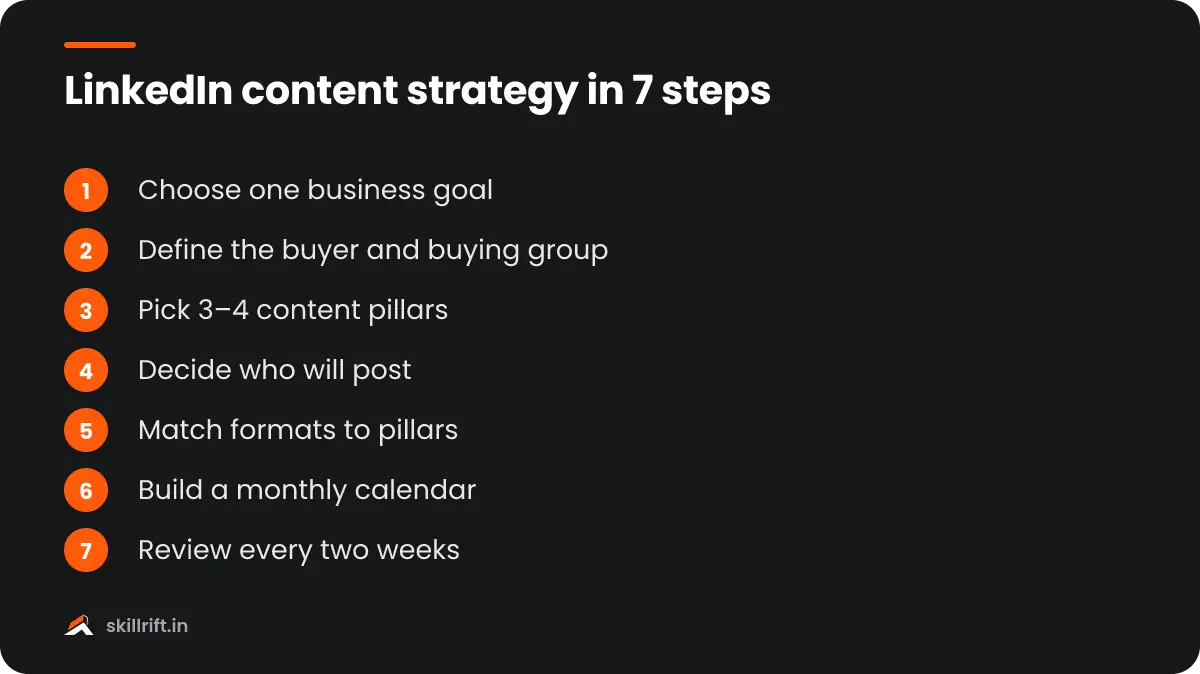
This guide walks through the full process, with an India-specific example and a monthly plan you can copy.
What is a LinkedIn content strategy?
It is the system behind your posts: the audience you are writing for, the topics you own, the formats you use and the numbers you track. Without it, LinkedIn activity turns into random posting that nobody remembers.
A good plan answers five questions in writing. Who exactly are we trying to reach? What do we want them to think, feel or do? Which topics give us the right to speak? Who on our team will post? And how will we know it is working?
Sprout Social’s LinkedIn content marketing guide suggests splitting your content into pillars and core topics, then tracking which pillars earn engagement. That is the backbone of the method below.
Free playbook
Get the free Social Media and Influencer Playbook
A 25-page guide covering strategy, content calendars, Reels and Shorts, LinkedIn, captions, analytics, influencer briefs, contracts and ASCI rules. We email it to you, plus occasional new guides. Unsubscribe anytime.
Why does LinkedIn matter for B2B brands in India?
LinkedIn is where Indian buyers, founders and managers go to think about work, which makes it the most natural place for B2B content. India is also one of its biggest markets, so your buyers are very likely already there.
LinkedIn says it has more than 1.4 billion members and 71 million companies on the platform worldwide. In February 2023, LinkedIn announced it had crossed 100 million members in India, with 56 per cent growth over the previous three years, making India its second-largest market after the US.
The bigger reason is how B2B buyers decide. A November 2026 Edelman and LinkedIn study, reported by O’Dwyer’s, surveyed 1,135 executives in seven countries including India. It found 82 percent of B2B decision-makers say thought leadership has become a more valuable factor in their decisions, and 59 percent said weak or missing thought leadership contributed to a vendor being removed from consideration.
For B2B marketers, the opportunity is to make thought leadership a source of influence throughout the commercial relationship.
Authors of the Edelman and LinkedIn study “From Found to Chosen”, as quoted in O’Dwyer’s, 13 November 2026
How do you build a LinkedIn content strategy step by step?
Work through seven steps in order: goal, audience, pillars, voices, formats, calendar and measurement. Each step takes an hour or two, and the whole plan fits on two pages.
Step 1: Choose one business goal
Pick the single result LinkedIn should drive this quarter, such as demo requests, webinar sign-ups or hiring applications. One goal keeps every post pointed in the same direction.
Write it as a sentence with a number you can count, for example “40 demo requests from LinkedIn between January and March”. You will judge every pillar and format against it.
Step 2: Define the buyer and the buying group
Name the job titles who use, approve and pay for what you sell. In most Indian B2B deals that means a user, a manager and a finance or founder sign-off.
Write down each person’s biggest work problem in their own words. Sales call notes, support tickets and LinkedIn comments on competitor posts are the best places to find those words.
Step 3: Pick three or four content pillars
Choose three or four themes where your buyer’s problem meets your expertise. Every post should fit one of them.
A simple mix is one pillar for practical how-to advice, one for your point of view on industry changes, one for proof (customer stories and product use) and one for the people and culture behind the brand.
Step 4: Decide who will post
Choose the company page plus two to five people: usually a founder, a sales or product lead and a subject expert. People follow people, and individual profiles usually reach further than a page.
Give each person one pillar they own, so posts don’t overlap. Our guide to building a personal brand online covers how employees can set up their profiles first.
Step 5: Match formats to each pillar
Assign a default format to each pillar, such as text posts for opinions, document carousels for frameworks and short videos for product demos. This stops you starting from a blank page each week.
Step 6: Build a monthly content calendar
Plan four weeks at a time in a shared sheet with columns for date, owner, pillar, format, hook and call to action. Leave one slot a week empty for news and replies to industry conversations.
Step 7: Set your review rhythm
Review results every two weeks and rework the plan every quarter. Keep the pillars that bring comments and conversations from your target titles, and drop the ones that don’t.
What should B2B brands post on LinkedIn?
Post things your buyer would save, forward to a colleague or bring up in a meeting. Practical advice and clear opinions beat company announcements almost every time.
| Pillar | What to post | Best format | Example for an Indian HR software brand |
|---|---|---|---|
| How-to advice | Checklists, templates, short explainers | Document carousel | “A payroll compliance checklist for companies with 50 to 200 staff” |
| Point of view | Your take on rules, trends and industry news | Text post | “What the new labour codes mean for your leave policy” |
| Proof | Customer stories, before-and-after workflows, demos | Short video or image | “How a Pune manufacturer moved attendance off paper” (with the customer’s permission) |
| People | Team stories, hiring, behind the scenes | Photo or text post | “What our support team learnt from 1,000 tickets this year” |
| Original data | Survey results, anonymised product data | Document or newsletter | “What we found when we asked 200 HR managers about hiring” |
The examples are illustrations of the type of post, not real campaigns. Only publish figures you can back up from your own data or a named source.
Which LinkedIn post formats work best?
No single format wins for every brand, so test the main ones against your goal. Text posts, document carousels, short videos, polls, newsletters and events each suit a different job.
- Text posts: fastest to make and best for opinions and lessons. Lead with a clear first line, because only the first two or three lines show before “see more”.
- Document carousels: good for frameworks, checklists and step-by-step guides that readers save.
- Short video: useful for product demos, customer interviews and founder explainers. Add captions, as many people watch on mute at work.
- Polls: quick reads on buyer opinion that can feed later posts. Use them sparingly.
- Newsletters: a LinkedIn newsletter from a founder or expert builds a subscribed audience for longer pieces.
- Events and live sessions: work well when your goal is webinar or event sign-ups.
If your team already makes short vertical videos, our Instagram Reels strategy guide covers hooks and editing that carry over well to LinkedIn video.
How often should a B2B brand post on LinkedIn?
Post as often as you can keep up with good quality for a full quarter. For most Indian small and mid-size B2B brands, that means two to three page posts a week and one or two posts a week from each key person.
Spread your posts through the working week and post when your buyers are at their desks. Check your page analytics after a month to see when your own followers are most active, rather than copying a “best time to post” chart.
Should you post from the company page or employee profiles?
Use both, but put more effort into people. The page gives you a home for jobs, product news and paid campaigns, while employee profiles carry opinions and stories that buyers trust.
A practical split is to let the page share and add context to employee posts, and to reshare the page’s most useful pieces from personal profiles with a line of personal comment.
How do you measure LinkedIn content performance?
Measure in three layers: reach, engagement from the right people, and business results. Likes alone tell you very little.
| Layer | What to track | Where to find it |
|---|---|---|
| Reach | Impressions, follower growth, unique viewers | LinkedIn page and post analytics |
| Right-audience engagement | Comments and profile views from your target job titles and companies | Post analytics demographics, comment lists |
| Business result | Demo requests, sign-ups, inbound messages, deals that mention LinkedIn | Website analytics with UTM links, CRM, a “how did you hear about us” field |
Tag every link you share with UTM parameters so your website analytics can tell LinkedIn traffic apart. Then ask every new lead how they heard about you, because a lot of LinkedIn influence never shows up as a click.
How does AI search change LinkedIn content?
Buyers now use AI tools to summarise and compare vendors, so clear, quotable expertise matters more. Posts and articles that state a specific view, back it with evidence and name the author are easier for both people and AI answers to pick up.
The same O’Dwyer’s report says 78 percent of respondents had researched a company after seeing its thought leadership cited by AI. Publishing your strongest ideas on your own blog as well as LinkedIn gives them a permanent, linkable home.
If you are deciding how much of your effort should go to organic posts versus paid reach, read our comparison of content marketing vs paid ads. To learn social strategy, content and analytics with live projects, see the SkillRift social media marketing course.
Our Take
We would start smaller than most guides suggest. Pick one goal, three pillars and two people who will genuinely post every week, and run that for 90 days before adding anything else. A founder writing one honest, specific post a week will usually do more than a polished page posting daily. Write about the problems you hear on sales calls, in the language your buyers use, and reply to every comment from a target buyer within a day. Judge the quarter by conversations started and leads that mention LinkedIn, not by follower count.
Common mistakes in a LinkedIn content strategy
Most plans fail for the same few reasons, and all of them are easy to fix once you see them.
- Posting only company news. Launches and awards matter to you, not your buyer. Keep them to a small share of posts.
- Relying on the page alone. Without employee voices, reach stays low and the brand feels faceless.
- No clear first line. If the opening line doesn’t earn the “see more” click, the rest of the post isn’t read.
- Copying global playbooks word for word. Indian buyers respond to local examples, rules and rupee figures.
- Tracking vanity metrics. Likes from students and peers can hide the fact that no target buyer is engaging.
- Giving up after a month. B2B trust builds slowly. Plan for a full quarter before you judge results.
Key takeaway: A strong LinkedIn content strategy is simple and written down: one goal, a few pillars your buyers care about, real people posting consistently, and a review every two weeks against leads, not likes.
Frequently asked questions
How many times a week should a B2B company post on LinkedIn?
For most small and mid-size B2B brands in India, two to three company page posts a week plus one or two posts a week from each key employee is a rhythm you can keep up. Consistency matters more than volume, so pick a number you can hold for a full quarter.
Is LinkedIn better than Instagram for B2B marketing?
For most B2B brands, yes. LinkedIn users are there in a work frame of mind, and you can reach people by job title, industry and company size. Instagram can still help with employer branding and founder visibility, but it is rarely the main B2B lead channel.
Do I need LinkedIn ads for a LinkedIn content strategy to work?
No. Organic posts from your page and your team can build reach and trust on a ₹0 media budget. Ads help when you need to reach a specific list of accounts quickly, or to put your best organic posts in front of decision-makers who don’t follow you yet.
Want a wider plan beyond LinkedIn? Our guide on how to build a content marketing strategy shows how LinkedIn fits with your blog, email and video.