What Are Influencer Rates in India? Prices by Platform
Influencer rates in India are estimates, not a fixed price list. Here are the published ranges by tier and platform, the extra costs, the tax rules and a quick way to check a quote.
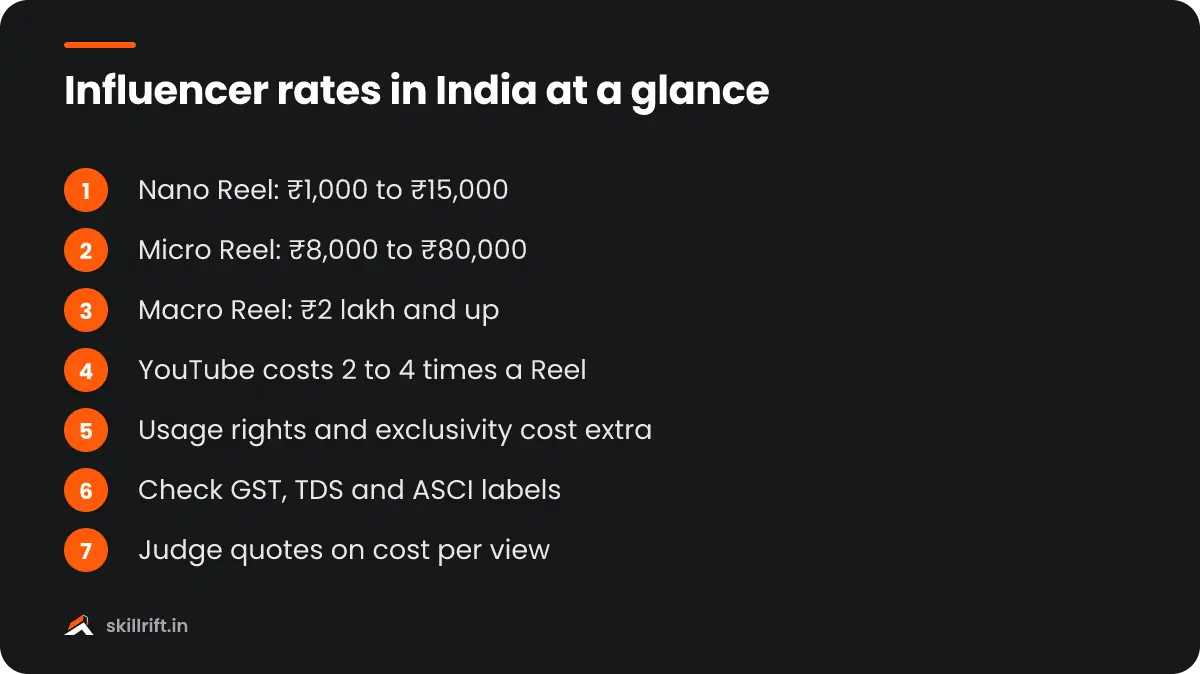
Influencer rates in India start at about ₹1,000 to ₹15,000 per post for nano creators and go past ₹25 lakh for celebrities, going by rate cards published in 2026. There is no official price list. Every figure is an estimate, and the final fee depends on platform, niche, format, usage rights and taxes.
What are influencer rates in India right now?
Published rate cards put a single Instagram Reel at roughly ₹1,000 to ₹15,000 for a nano creator, ₹8,000 to ₹80,000 for a micro creator and ₹2 lakh or more for a macro creator. These are benchmarks from agencies and booking platforms, not fixed prices.
India has no regulator or industry body that sets creator fees. What you find online are estimates from companies that book creators for brands. Three of the most detailed ones are from upGrowth, Grynow and StarClinch. upGrowth states its numbers are its own estimates for September 2026 and should be used as negotiation benchmarks.
Because each source draws its tiers a little differently, the useful number is not one figure. It is the range across sources, which tells you where a quote is normal and where it is high.
Free playbook
Get the free Social Media and Influencer Playbook
A 25-page guide covering strategy, content calendars, Reels and Shorts, LinkedIn, captions, analytics, influencer briefs, contracts and ASCI rules. We email it to you, plus occasional new guides. Unsubscribe anytime.
How much do influencers charge by follower tier and platform?
The fee rises with follower count, but the ranges overlap a lot. The table below puts the three published rate cards side by side so you can see the spread for one Instagram Reel or post.
| Tier (followers) | upGrowth | Grynow | StarClinch |
|---|---|---|---|
| Nano (1K to 10K) | ₹2,000 to ₹8,000 | ₹1,000 to ₹12,000 | ₹2,000 to ₹15,000 |
| Micro (10K to 100K) | ₹8,000 to ₹80,000 | ₹8,000 to ₹80,000 | ₹15,000 to ₹80,000 |
| Mid-tier (100K to 500K) | ₹50,000 to ₹3.5 lakh | ₹50,000 to ₹3.5 lakh | ₹80,000 to ₹5 lakh (its 100K to 1M band) |
| Macro (500K to 2M) | ₹2 lakh to ₹12 lakh | ₹2 lakh to ₹12 lakh | ₹5 lakh to ₹25 lakh (its 1M to 5M band) |
| Mega and celebrity | ₹8 lakh to ₹1 crore+ per campaign | ₹6 lakh to ₹25 lakh+ | ₹25 lakh to ₹2 crore+ (5M+) |
Two things stand out. The micro tier has a ten-times gap between its lowest and highest figure, so “micro” alone tells you very little. And StarClinch uses wider follower bands, which is why its top figures look higher.
Use the table as a sanity check. If a creator with 40,000 followers quotes ₹30,000 for a Reel, that sits inside every range. If the quote is ₹3 lakh, ask what else is included.
What do Instagram influencers charge per Reel, post and Story?
On Instagram, Reels cost the most, static posts a little less and Stories the least. StarClinch’s platform table gives one of the few format-level breakdowns for India.
| Instagram format | Micro (10K to 100K) | Macro (100K to 1M) |
|---|---|---|
| Reel | ₹20,000 to ₹90,000 | ₹1 lakh to ₹5 lakh |
| Static post | ₹15,000 to ₹60,000 | ₹80,000 to ₹3 lakh |
| Story (5 slides) | ₹8,000 to ₹30,000 | ₹40,000 to ₹1.5 lakh |
Bundles are cheaper per piece. upGrowth estimates that a Reel, Story and feed post combination costs 1.6 to 2 times a single Reel, and a package of three Reels costs 2.2 to 2.5 times one Reel. So ask for a package price before you ask for a discount.
If you run a local shop or service, read our Instagram marketing guide for local businesses before you spend on creators. Your own profile has to be ready to convert the visitors a creator sends.
How much do YouTube, LinkedIn and podcast creators charge?
YouTube integrations cost more than Reels because long videos take longer to make and keep getting views. LinkedIn and podcast rates are quoted less often, but published ranges exist.
| Platform and format | Published range | Source |
|---|---|---|
| YouTube dedicated video, micro | ₹30,000 to ₹1.5 lakh | StarClinch |
| YouTube 60-second integration, micro | ₹15,000 to ₹60,000 | StarClinch |
| YouTube Shorts, micro | ₹10,000 to ₹40,000 | StarClinch |
| YouTube integrated video, mid-size channel | About ₹2 lakh to ₹6 lakh | Grynow |
| LinkedIn post, 30K to 100K followers | About ₹40,000 to ₹2.5 lakh | Grynow |
| Podcast host-read mid-roll | About ₹30,000 to ₹3 lakh | Grynow |
upGrowth puts a YouTube integration at two to four times the price of a Reel from a creator of similar size, and says Shorts are priced close to Reels. For B2B products, a LinkedIn creator with a small but relevant audience can be a better buy than a large lifestyle account.
What factors change an influencer’s price?
Five things move the fee more than follower count: platform, niche, format, usage rights and exclusivity. Two creators with the same followers can quote very different amounts because of these.
- Platform and format: a dedicated YouTube video costs more than a Reel, and a Reel more than a Story.
- Niche: finance, technology and other expert niches charge more than general lifestyle content.
- Engagement: a creator whose audience comments and saves can justify a higher fee than a bigger account with silent followers.
- Usage rights: upGrowth estimates that brand repost rights add 25% to 40% to the fee, and running the creator’s post as an ad from their handle (whitelisting) adds 60% to 120%.
- Exclusivity: asking the creator not to work with competitors for 30 days adds an estimated 30% to 50%.
Turnaround time and the number of revisions also matter. A two-day deadline during Diwali week will cost more than the same Reel booked a month ahead.
Are nano and micro influencers better value for small brands?
For most small budgets, yes. Smaller creators cost less per post, and many Indian brands already prefer them for that reason.
EY and Big Bang Social’s report “The State of Influencer Marketing in India” projected the industry to reach ₹3,375 crore by 2026. As reported by afaqs!, 47% of brands in that survey preferred micro and nano influencers because of the lower cost per reach. The same report found that 71% of brands paid a fixed fee, while 29% were exploring performance-linked models.
Influencers are stepping in to provide guidance, reassurance, and advice, effectively assuming the role of contemporary heroes.
Amiya Swarup, Partner, Marketing Advisory, EY India, quoted in afaqs!
The trade-off is effort. Ten nano creators mean ten briefs, ten approvals and ten invoices. If you have no time to manage that, one or two micro creators are easier to handle.
What extra costs sit on top of the creator’s fee?
Budget for agency or platform fees, production, paid amplification and product seeding on top of the fee. upGrowth’s estimates give a sense of scale.
- Agency commission: 15% to 25% of creator spend, or a project fee of ₹50,000 to ₹5 lakh per campaign.
- Self-serve platforms: ₹25,000 to ₹3 lakh a month, or 8% to 15% of spend.
- Talent manager commission: 15% to 25% on macro and celebrity deals.
- Scripts and production: ₹15,000 to ₹50,000 when the brand needs a higher-quality shoot.
- Product seeding: ₹25,000 to ₹2 lakh, and 10% to 30% of products sent out never get posted.
If you plan to run the creator’s content as an ad, the media budget is separate. Our guide on learning Meta Ads explains how partnership ads and budgets work.
How do GST, TDS and ASCI rules affect the cost?
Tax and disclosure rules change both the invoice amount and the work involved. Check all three before you sign.
GST: a creator must register for GST once turnover crosses ₹20 lakh (₹10 lakh in special category states), and a registered creator adds GST to the invoice, as upGrowth’s guide notes. Ask whether the quote includes GST.
TDS on free products: under Section 194R, a brand deducts 10% TDS on benefits worth more than ₹20,000 in a financial year. Products the creator keeps count; products that are returned do not. The same guide points out that the Income-tax Act, 2025 replaced the 1961 Act from 1 April 2026, so confirm the current section and rate with your chartered accountant.
Disclosure: the ASCI guidelines for influencer advertising require a clear label such as “Ad”, “Sponsored”, “Collaboration” or “Partnership”, placed upfront where an average viewer will not miss it. For videos of 15 seconds or less, the label must stay for at least 3 seconds. For longer videos under 2 minutes, it should stay for one-third of the video. A free gift also counts as a material connection, so barter posts need a label too.
How do you check if an influencer’s quote is fair?
Convert the quote into cost per view and cost per engagement, then compare it with the tier ranges and with your paid ads. This takes ten minutes and needs no paid tool.
- Ask for a screenshot of insights for the creator’s last ten Reels or videos: views, likes, comments, saves and shares.
- Work out the average views and average engagements per post. Ignore the one viral post.
- Divide the fee by average views to get cost per view, and by average engagements to get cost per engagement.
- Compare creators on these two numbers, not on followers.
- Compare with your paid ads. upGrowth suggests a creator is competitive if cost per engaged view is within 1.5 times what you pay on ads, and overpriced at 3 times or more.
Example: a creator quotes ₹20,000 for one Reel and their last ten Reels average 25,000 views and 1,500 engagements. Cost per view is ₹0.80 and cost per engagement is about ₹13.30. Another creator quotes ₹12,000 but averages 6,000 views, which is ₹2 per view. The first creator is cheaper where it matters, even though the fee is higher.
How much should a small business budget for influencer marketing?
Start with a test of three to five nano or micro creators and judge them on sales or leads, not likes. Going by the published nano and micro ranges, such a test can be run within a few tens of thousands of rupees.
Agencies quote much higher starting points. Grynow describes a starter budget as ₹1.5 lakh to ₹3 lakh a month, which includes management. If you manage creators yourself, you pay only the creator fees, product cost and taxes.
Give every creator a separate coupon code or a UTM link so you can see who drove orders. Our Google Analytics 4 setup guide shows how to track those links. If you are new to this channel, start with how to learn influencer marketing.
To plan creators alongside organic content and paid social, the SkillRift social media marketing course covers campaign planning step by step.
Our Take
Pay for what you can measure. Before you agree on a fee, ask for average views on the last ten posts, not the best one, and work out cost per view. Start with a small paid test across a few micro creators with tracked links, then put more money behind the one or two who bring orders. Put the deliverables, usage rights, timeline and disclosure label in writing, even for a ₹5,000 deal. And do not treat barter as free: the product, courier and your time all cost money.
Common mistakes when paying influencers
Most overspending comes from judging creators by followers and skipping the paperwork. Avoid these.
- Paying on follower count without checking average views and engagement.
- Not asking whether the quote includes GST and agency commission.
- Using the creator’s video in ads without buying usage rights first.
- Skipping a written agreement on deliverables, deadline and revisions.
- Letting a paid or barter post go out without an ASCI disclosure label.
- Spending the whole budget on one large creator instead of testing several small ones.
- Having no coupon code or tracked link, so you cannot tell what worked.
Frequently asked questions
How much does an influencer with 10K followers charge in India?
A creator with around 10,000 followers sits between the nano and micro tiers. Published 2026 rate cards put that at roughly ₹2,000 to ₹15,000 for one Instagram Reel or post, depending on niche and engagement.
Do influencers in India work for free products?
Many nano creators accept barter deals, especially for products they would use anyway. The post still needs a disclosure label under ASCI rules, and products worth more than ₹20,000 in a year can attract TDS.
Can you negotiate influencer rates?
Yes. Rate cards are starting points. You get a better price by booking a package of posts, giving a longer deadline or reducing usage rights, than by simply asking for a discount.
Key takeaway: influencer rates in India are estimates, not a fixed price list. Compare a quote against the published tier ranges, convert it to cost per view, add GST, TDS and usage rights, and test small before you scale.