Top 30 Technical SEO Interview Questions and Answers (2026)
30 technical SEO interview questions with model answers on crawling, canonicals, JavaScript rendering and Core Web Vitals, plus 2026 salary ranges in India.

The technical SEO interview questions asked in India in 2026 focus on five areas: crawling and indexing, site architecture and canonicals, JavaScript rendering, Core Web Vitals, and structured data. Expect scenario questions too, such as diagnosing a sudden traffic drop. Below are 30 questions with model answers and what the interviewer is really testing.
I have sat on both sides of these rounds, at Delhi NCR agencies and D2C brands. The pattern behind technical SEO interview questions is consistent: interviewers want proof you have fixed something real, prioritised it and explained it to a developer.
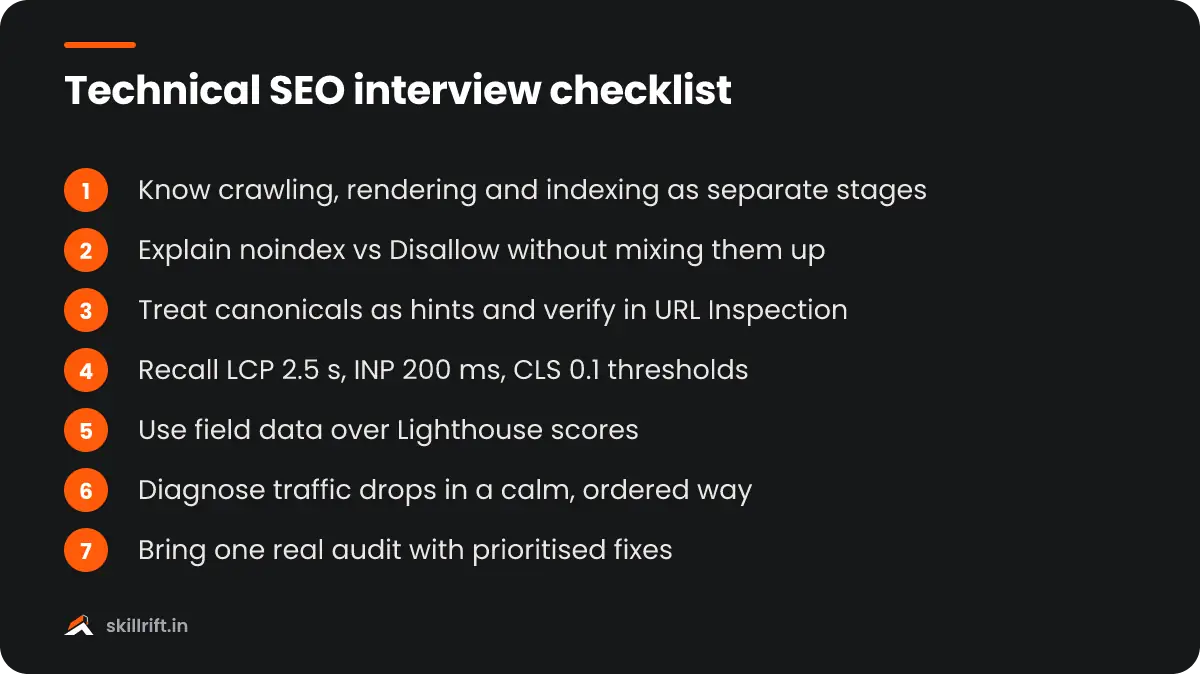
Use this list alongside our broader SEO interview questions and answers if the role also covers content and link building.
Crawling and indexing questions
These questions check how a page gets from your server into Google’s index. Almost every round of technical SEO interview questions starts here.
1. What is technical SEO, and how is it different from on-page SEO?
Technical SEO makes sure search engines can crawl, render, index and understand a site efficiently. It covers server responses, site architecture, canonicals, page speed, structured data and rendering. On-page SEO works on the content of a single page: the title, headings, copy and intent match.
What interviewers look for: A clear boundary and an example of a technical fix you have actually made.
2. Explain crawling, rendering and indexing.
Crawling is Googlebot fetching a URL. Rendering is Google running the page in an evergreen Chromium-based renderer so JavaScript-added content becomes visible. Indexing is Google processing that content, choosing a canonical and storing it so it can be shown in results. A page can be crawled but never indexed.
What interviewers look for: That you know these are separate stages with separate failure points.
3. What is crawl budget, and when does it matter?
Crawl budget is the number of URLs Googlebot can and wants to crawl on a site in a given period. Google says it mainly matters for very large sites or medium sites whose content changes daily. A 300-page service site rarely has a crawl budget problem; a marketplace with millions of filter URLs often does.
What interviewers look for: That you do not blame crawl budget for every indexing issue on a small site.
4. What does robots.txt do, and what can it not do?
Robots.txt tells crawlers which paths they may not fetch. It does not remove pages from the index. A blocked URL can still be indexed from external links, just without its content. Google only reads the first 500 KiB of the file.
What interviewers look for: The difference between blocking crawling and blocking indexing.
5. What is the difference between noindex and a Disallow rule?
Noindex is a meta robots tag or X-Robots-Tag header that tells Google not to index a page. Disallow in robots.txt stops crawling. If you disallow a page, Google cannot crawl it to see the noindex, so the URL may stay indexed. To remove a page, allow crawling, add noindex, wait for it to drop, then block it if needed.
What interviewers look for: This classic trap question. Getting the order right signals real experience.
6. How do you use the Page indexing report in Search Console?
I start with the reasons pages are not indexed and look for patterns by template. “Discovered, currently not indexed” usually points to crawl priority or weak internal linking. “Crawled, currently not indexed” usually means Google saw the page and judged it low value or duplicate. I then use URL Inspection on sample URLs to confirm.
What interviewers look for: Pattern-level thinking instead of fixing URLs one by one.
7. What should an XML sitemap contain?
Only canonical, indexable URLs that return 200. No redirects, no noindexed pages, no parameter duplicates. Each file can hold up to 50,000 URLs or 50 MB uncompressed, and larger sites use a sitemap index. Google ignores the priority and changefreq fields.
What interviewers look for: Knowing that a sitemap is a hint for discovery, not a guarantee of indexing.
Free playbook
Get the free Career and Interview Kit
A 25-page guide covering roles, a learning roadmap, portfolio projects, resume and LinkedIn templates, 55+ interview questions with answers and case assignments. We email it to you, plus occasional new guides. Unsubscribe anytime.
Site architecture, canonical and redirect questions
Architecture questions test whether you can control which URLs exist and which version should rank.
8. What is a canonical tag, and does Google always follow it?
A rel=”canonical” tag tells Google which URL is the preferred version among duplicates. It is a strong hint, not a directive. Google also looks at redirects, internal links, sitemaps and HTTPS when choosing a canonical.
What interviewers look for: That you check the Google-selected canonical in URL Inspection rather than assuming.
9. How would you handle duplicate URLs created by parameters?
First, find out which parameters exist and why: tracking, sorting, filtering or session IDs. Tracking and sort parameters should canonicalise to the clean URL. Internal links should never include tracking parameters. For filter combinations with no search demand, I keep them out of internal links and, if they create crawl waste, block the patterns in robots.txt. Google retired its URL Parameters tool in 2022, so this is now handled on the site itself.
What interviewers look for: A layered approach rather than one tag applied everywhere.
10. When do you use a 301, a 302 and a 410?
A 301 is for permanent moves and consolidates signals to the new URL. A 302 is for temporary moves, such as a seasonal sale page. A 410 says the page is gone on purpose, which Google tends to drop slightly faster than a 404. Redirecting deleted products to the homepage often gets treated as a soft 404.
What interviewers look for: Judgement about when not to redirect.
11. What are redirect chains, and why fix them?
A chain is when URL A redirects to B, which redirects to C. Googlebot follows up to 10 hops, but every hop wastes crawl time, slows users and adds risk of a loop. After migrations, I update internal links and old redirects to point straight to the final URL.
What interviewers look for: That you fix the source links, not just the redirects.
12. How would you plan a site migration?
Crawl the old site and export every indexable URL with its traffic and backlinks. Build a one-to-one redirect map, test it on staging, and keep staging blocked from indexing. On launch day, crawl the redirect list, check canonicals and robots.txt, submit new sitemaps and watch Search Console daily for four to six weeks.
What interviewers look for: A checklist mindset and clear ownership of the redirect map.
13. What is faceted navigation, and why is it risky?
Facets are filters such as size, colour and price on category pages. Combined, they can create millions of near-duplicate URLs. On a fashion D2C site, “kurtas + cotton + blue + under ₹999” may deserve an indexable page because people search for it, while “sort by newest + page 7” does not. The skill is deciding which combinations to expose.
What interviewers look for: Using keyword demand to decide which facets get indexable URLs.
14. What is the technical role of internal linking?
Internal links are how Google discovers pages and understands their relative importance. I look for orphan pages with no internal links, important pages buried more than three or four clicks deep, and links rendered only on click or hover.
What interviewers look for: That you treat internal links as a crawl and priority tool, not only a UX feature.
JavaScript and rendering questions
Rendering-focused technical SEO interview questions decide whether you can work on React or Next.js sites, now common at Indian startups.
15. How does Google process JavaScript pages?
Google crawls the HTML, then queues the page for rendering, where its renderer executes JavaScript and reads the final DOM. Content that appears only after user interaction, or depends on blocked scripts, may never be seen. Links must be real anchor tags with an href to be followed.
What interviewers look for: Awareness that “Google renders JavaScript” does not mean “Google sees everything”.
16. Compare client-side rendering, server-side rendering and static generation for SEO.
With client-side rendering, the server sends a near-empty shell and the browser builds the page, which delays content and can hide it from crawlers. Server-side rendering sends complete HTML per request. Static generation builds HTML in advance, which is fast and safe. For SEO, I prefer SSR or static generation for any page that needs to rank.
What interviewers look for: A practical recommendation, not just definitions.
17. How do you check whether Google sees content loaded by JavaScript?
Run URL Inspection, use the live test and view the rendered HTML and screenshot. I also compare a Screaming Frog crawl with JavaScript rendering on and off to see what changes.
What interviewers look for: A repeatable testing method.
18. Is dynamic rendering still a good solution?
Google describes dynamic rendering, serving pre-rendered HTML to bots and JavaScript to users, as a workaround rather than a long-term solution. I would recommend moving key templates to server-side rendering or static generation instead.
What interviewers look for: Up-to-date knowledge of Google’s guidance.
Page speed and Core Web Vitals questions
These test whether you can turn performance data into developer tasks. Most Indian users browse on mid-range Android phones, so this carries weight.
19. What are the Core Web Vitals and their “good” thresholds?
Largest Contentful Paint measures loading and should be 2.5 seconds or less. Interaction to Next Paint measures responsiveness and should be 200 milliseconds or less. INP replaced First Input Delay in March 2024. Cumulative Layout Shift measures visual stability and should be 0.1 or less. Each is assessed at the 75th percentile of real visits. Google explains the details on web.dev.
What interviewers look for: Exact thresholds, the 75th percentile and the INP change.
20. What is the difference between field data and lab data?
Field data comes from real Chrome users through the Chrome UX Report and is what Search Console shows. Lab data comes from a simulated test such as Lighthouse. A page can score 95 in Lighthouse and still fail INP for real users on budget phones.
What interviewers look for: Knowing which data source to trust for which decision.
21. How would you improve LCP on a slow product page?
Find the LCP element first, usually the hero product image. Then serve it in WebP or AVIF at the right size, avoid lazy-loading it, add fetchpriority=”high”, preload it if it is discovered late, and cut server response time with caching or a CDN.
What interviewers look for: Diagnosis before fixes, and fixes in order of impact.
22. What causes poor INP, and how is it fixed?
Poor INP comes from long JavaScript tasks blocking the main thread when a user taps, often from heavy chat widgets, tag managers loaded with many pixels, or large framework bundles. Fixes include breaking up long tasks, deferring non-essential scripts, reducing third-party tags and giving instant visual feedback on tap.
What interviewers look for: Familiarity with real causes such as third-party scripts.
23. What does mobile-first indexing mean for an audit?
Google primarily uses the mobile version of a page for indexing and ranking. So the mobile version must have the same main content, structured data, metadata and internal links as desktop. Hiding sections or links on mobile to “clean up” the design can quietly remove them from Google’s view.
What interviewers look for: Checking content parity, not just mobile-friendliness.
Structured data, international and AI search questions
These technical SEO interview questions test whether your knowledge is current, because Google has changed its rich results several times since 2023.
24. What is structured data, and which types still matter?
Structured data is code, usually JSON-LD, that describes a page’s entities to search engines. Product, Review snippets, Breadcrumb, Article, Organization, LocalBusiness and Video remain useful. Google has steadily cut rich result types: HowTo results went in 2023, several more in 2025, and FAQ rich results were retired in 2026. Markup must match visible content.
What interviewers look for: Current knowledge and testing with the Rich Results Test.
25. How does hreflang work?
Hreflang tells Google which language or regional version to show, for example en-in for India and en-gb for the UK. Every version must list all the others, including itself, and links must be reciprocal. Add x-default for a fallback page. Missing return links are the most common error.
What interviewers look for: Reciprocity and correct language-region codes.
26. How do you make a site technically eligible for AI Overviews?
Google says there is no special markup for AI Overviews. A page needs to be indexed and eligible to show a snippet, so the normal technical basics apply. Controls such as nosnippet limit how content is shown. Blocking the Google-Extended token affects Gemini model use, not Search or AI Overviews.
What interviewers look for: That you separate hype from documented behaviour.
Scenario, tool and communication questions
Scenario-based technical SEO interview questions are where most candidates are separated. The interviewer wants to watch you think.
27. Organic traffic dropped 40% overnight. What do you check first?
Confirm it is real in both Search Console and GA4, not a tracking break. Check whether the drop is site-wide or limited to a template, folder or device. Then look for recent deployments: a noindex left from staging, a robots.txt change, broken canonicals or a failed redirect. Finally, compare the date with Google’s Search Status Dashboard for core updates.
What interviewers look for: A calm, ordered diagnosis that rules out the simple causes first.
28. Which tools do you use for a technical audit?
Google Search Console for indexing and performance, Screaming Frog for crawling (free up to 500 URLs, paid licence roughly ₹22,000 to ₹24,000 a year depending on the exchange rate), PageSpeed Insights for Core Web Vitals and Chrome DevTools for rendering and network checks. Ahrefs Webmaster Tools is free for verified sites. See our list of free SEO tools for more.
What interviewers look for: Purpose for each tool, not a long list of logos.
29. How do you prioritise technical issues?
I score each issue by impact on revenue pages, number of URLs affected and effort for developers. Template-level problems come first, because one fix can repair thousands of pages. A noindex on product pages beats a missing alt tag on a blog image every time.
What interviewers look for: Business sense, not a list of 400 crawl warnings.
30. How do you get developers to implement your recommendations?
Write tickets the way developers work: the problem, sample URLs, expected behaviour, acceptance criteria and how to test. Explain the business impact in one line. Recrawl after release to confirm.
What interviewers look for: Collaboration skills, which often decide the offer.
Technical SEO salary in India in 2026
Technical SEO pays more than general SEO because fewer candidates handle rendering and migrations. These are typical ranges from job portals and postings, not guarantees.
| Role | Experience | Typical salary (per year) |
|---|---|---|
| SEO executive | 0 to 2 years | ₹3 lakh to ₹6 lakh |
| Technical SEO specialist | 2 to 4 years | ₹6 lakh to ₹12 lakh |
| Senior technical SEO or SEO lead | 5+ years | ₹12 lakh to ₹25 lakh |
Bengaluru, Gurugram and Mumbai usually pay towards the upper end, and product companies tend to outpay small agencies.
How to prepare for technical SEO interview questions
The best preparation for technical SEO interview questions is a real audit you can talk through. Definitions get you through the first ten minutes; evidence gets you the offer.
- Pick a real site, ideally a local business or a friend’s Shopify store, and crawl it.
- Check its indexing, canonicals, sitemaps and Core Web Vitals, and note five issues.
- Prioritise those issues and write one developer ticket for the top fix.
- Read Google’s crawling and indexing documentation so your answers match current guidance.
- Practise explaining each fix in two sentences to a non-technical manager.
If you are still building fundamentals, start with our guide on how to learn SEO from scratch. Work through these technical SEO interview questions out loud, ideally with a friend playing the interviewer. If you want structured practice with live audits and feedback, the SkillRift SEO course covers technical SEO on real sites, or you can join the free masterclass first.
Frequently asked questions
How should a fresher prepare for technical SEO interview questions?
Audit one real website end to end. Crawl it with the free Screaming Frog version, check Search Console indexing reports, run PageSpeed Insights on key templates and write up five prioritised fixes. Bringing that audit to the interview proves practical skill far better than memorised definitions.
Do I need to know coding for a technical SEO role?
You do not need to be a developer, but you should read HTML comfortably, understand how JavaScript changes a page, and know basic HTTP status codes. Writing a simple regex for Search Console filters is a strong plus.
What is the salary of a technical SEO specialist in India?
It typically ranges from about ₹6 lakh to ₹12 lakh a year for someone with two to four years of hands-on experience, with Bengaluru, Gurugram and Mumbai paying towards the top. Freshers usually start as SEO executives at ₹3 lakh to ₹6 lakh. Senior leads can cross ₹20 lakh.
Which tools are most often asked about in technical SEO interviews?
Google Search Console comes up in almost every round, followed by Screaming Frog, PageSpeed Insights and Chrome DevTools. Agencies may also ask about Ahrefs or Semrush site audits. Interviewers care less about which paid tool you used and more about how you interpreted the data and what you fixed.
Are technical SEO interview questions different for agency and in-house roles?
Yes, slightly. Agency rounds lean on audits across many site types and client communication. In-house roles, especially at e-commerce or D2C brands, go deeper into one platform, site migrations, faceted navigation and working with developers through sprints and tickets.