What Is AI Overviews SEO? How to Get Cited by Google
AI Overviews SEO is about being one of the sources Google's AI answer links to. Here is how Google picks those pages, six steps to get cited and how to track it from India.
AI Overviews SEO is the work of getting your page cited as a source in the AI-written summary that Google shows above its normal results. You do it with the same foundations as regular SEO: an indexed page, a clear direct answer, facts with sources and coverage of the related questions Google searches behind the scenes. No special tag or file is needed.
What is AI Overviews SEO?
AI Overviews SEO means shaping your content so Google’s AI summary picks it as one of its linked sources. The goal shifts from “rank number one” to “be one of the pages the answer is built from”.
An AI Overview is the short generated answer at the top of some Google results, with links to the pages it drew from. It shows mostly for questions. A Pew Research Center study of 68,879 Google searches by 900 US adults in March 2025 found that 18% of searches produced an AI summary. For searches starting with a question word such as who, what, when or why, the share was 60%.
So the pages most affected are the ones answering “what is”, “how to” and “which is better” searches. If your blog or business site depends on such queries, this is now part of your SEO work, not a separate job.
Free playbook
Get the free SEO Playbook
A 25-page guide covering keyword research, content, on-page and technical SEO, Core Web Vitals, local SEO in India, link building, AI search and a 90-day plan. We email it to you, plus occasional new guides. Unsubscribe anytime.
How does Google choose which pages to cite?
Google runs several related searches for one question and builds the answer from pages that show up across them. Google calls this “query fan-out”.
Google’s own guide, AI features and your website, describes it as issuing multiple related searches across subtopics and data sources. Someone who types “best laptop for students” may trigger hidden searches on battery life, price ranges and weight. A page that answers those sub-questions well can be cited even if it does not rank for the main keyword.
Recent data supports this. Ahrefs studied 863,000 keyword results and 4 million cited URLs, and reported in March 2026 that only 38% of pages cited in AI Overviews also ranked in the top 10 for the same search. In its July 2025 study the figure was about 76%.
AI Overviews are relying less on the direct search results and more on the sources showing up in fan out query SERPs.
Louise Linehan, Content Marketer, Ahrefs, in Ahrefs’ AI Overview citations study
For a small Indian site this is good news. You do not have to beat the biggest domain for the head keyword. You have to be the clearest answer to one of the sub-questions.
Is AI Overviews SEO different from normal SEO?
No, the foundation is the same, but the emphasis changes. Google states there are no additional requirements to appear in AI Overviews or AI Mode beyond being indexed and eligible to show with a snippet.
What changes is where you put your effort:
| Area | Classic SEO focus | AI Overviews SEO focus |
|---|---|---|
| Target | One main keyword per page | The main question plus its sub-questions |
| Winning result | A top-three blue link | A cited source inside the answer |
| Content shape | Long, complete guide | Short direct answers under clear headings |
| Proof | Backlinks and authority | Sourced facts, named experts, first-hand detail |
| Measurement | Position and clicks | Impressions, clicks and whether you are cited |
| Technical | Crawlable and indexable | The same, plus snippets must be allowed |
Google also says you do not need new machine-readable files, AI text files or special markup. Be careful of anyone selling an “AI Overviews plugin” or a paid llms.txt setup as a ranking fix.
How do you get cited in AI Overviews?
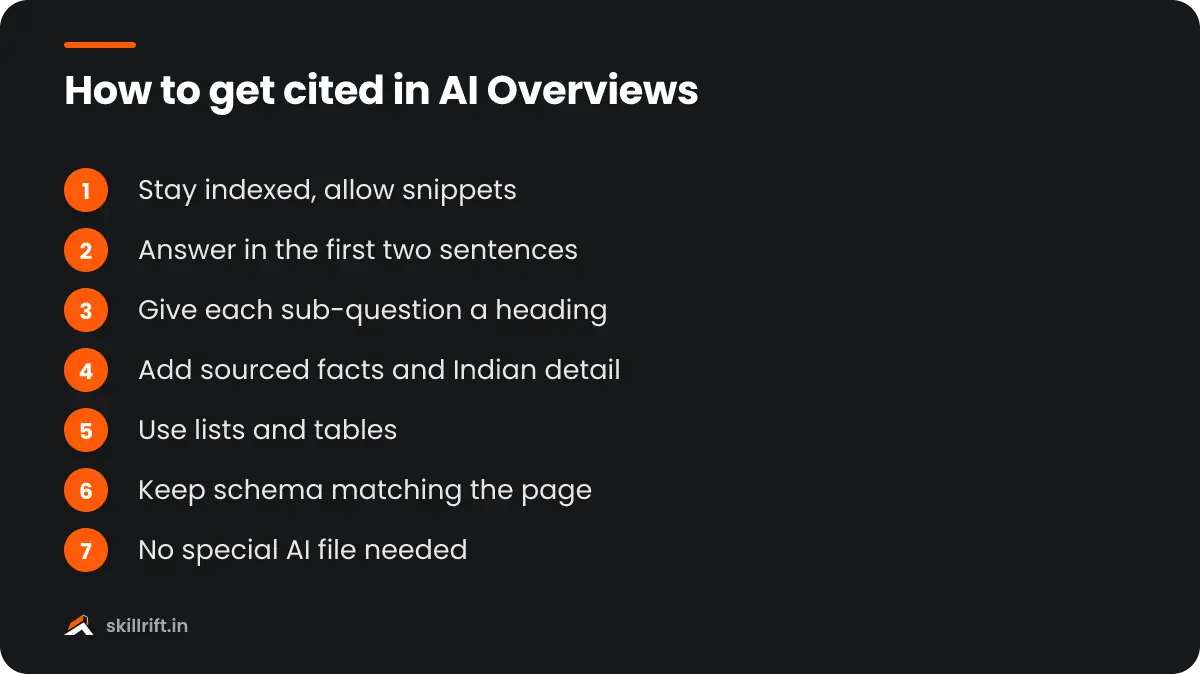
Make the page eligible, answer the question in the first lines, cover the sub-questions and back your claims with sources. These six steps apply to any site.
Step 1: Check the page is indexed and snippet-eligible
Use the URL Inspection tool in Search Console to confirm the page is indexed. Make sure it has no noindex or nosnippet tag and that robots.txt does not block Googlebot. Our technical SEO audit checklist covers these checks.
Step 2: Answer the question in the first two sentences
Put a plain answer of 40 to 60 words directly under the title and under every heading. Each answer should make sense when read alone, because that is how it may be quoted.
Step 3: Map the sub-questions and give each a heading
List the questions people ask around your topic from People Also Ask, autocomplete and Search Console queries. Give each one its own H2 or H3 phrased as a question. The process is the same as in our free keyword research guide.
Step 4: Add facts, sources and something original
Include numbers with a link to where they came from, and add what other pages lack: Indian prices in ₹, a worked example, a comparison or your own screenshots. A page that only repeats others gives Google no reason to cite it.
Step 5: Use lists and tables for comparisons and steps
Put steps in numbered order and comparisons in a table. Keep important content as text on the page, not inside images. Google lists text availability among its best practices.
Step 6: Keep schema honest and the page fresh
If you use structured data, Google says it must match the visible text. Update dates, prices and screenshots when things change, and keep your Google Business Profile current if you serve local customers.
Do AI Overviews reduce clicks to websites?
Yes, on average people click less when a summary appears. In the Pew study, users clicked a traditional result on 8% of visits to pages with an AI summary, compared with 15% on pages without one.
Links inside the summary were clicked on only 1% of those visits. And 26% of visits with an AI summary ended the browsing session, against 16% without. This is US data from March 2025, so treat it as a direction, not an exact figure for India.
Two things follow. First, being cited is worth less in clicks than a top ranking used to be, so count brand visibility as part of the return. Second, the clicks you do get may be better. Google says clicks from results pages with AI Overviews are higher quality, with visitors more likely to spend more time on the site. That is Google’s own claim, so check it against your enquiries and sales.
How do you track AI Overviews in Search Console?
You cannot see them separately. Google counts AI Overview impressions and clicks inside the normal Performance report under the “Web” search type, with no dedicated filter.
Use these workarounds:
- Watch question queries. Filter queries containing “what”, “how” or “which”. Rising impressions with falling CTR often points to an AI Overview.
- Check by hand. Search your 20 most important questions each month in an incognito window and note whether a summary shows and who is cited.
- Track conversions, not only clicks. Set up leads and sales properly using our Google Analytics 4 setup guide.
- Keep a simple sheet. Query, summary shown (yes/no), cited (yes/no), date. Three months of this beats any guess.
Can small Indian websites get cited?
Yes. Because most cited pages now come from outside the top 10 for the main search, a focused page from a small site can be chosen for a specific sub-question.
Your edge is local detail that global sites do not have. Write the answer for India: fees in ₹, GST rules, UPI steps, Indian exam dates, city-level examples, Hindi or Hinglish terms people actually type. A global guide to “how to start an online store” cannot answer “which payment gateway charges the least for a small seller in India”. You can.
Pair this with careful use of AI writing tools. Drafts are fine, but the facts and examples must be yours, as explained in how to use ChatGPT for SEO.
Our Take
Start with pages you already have, not new ones. Pick five posts that get impressions for question searches, and for each one rewrite the opening and the first lines under every heading into direct answers. Then add the two or three sub-questions the page skips. In our view this is the best use of an afternoon in AI Overviews SEO, because it costs nothing and improves the page for human readers at the same time. We would not spend money on tools that promise citations.
Common mistakes in AI Overviews SEO
Most mistakes come from treating this as a trick instead of clearer writing. Avoid these:
- Buying special files or plugins. Google says no new markup or AI text file is needed.
- Blocking snippets by accident. A nosnippet tag or a low max-snippet value removes you from consideration.
- Burying the answer. A 200-word introduction before the answer gives Google nothing to quote.
- Chasing only the head keyword. The sub-questions are where smaller sites get cited.
- Using statistics without sources. Unsourced numbers weaken trust for readers and for Google.
- Blocking Googlebot to “stop AI”. That removes you from Search itself. Google-Extended is a separate control for training and does not affect Search.
Key takeaway: AI Overviews SEO is ordinary SEO done with more discipline. Stay indexed, answer first, cover the sub-questions, cite your sources and add Indian detail that others lack.
To learn this properly with keyword research, on-page SEO and Search Console practice, see the SkillRift SEO course.
Frequently asked questions
Do I need schema markup to appear in AI Overviews?
No. Google says no special markup or new file is required. Schema can still help Google understand a page, but it must match the visible text and it does not guarantee a citation.
Can I stop my site from appearing in AI Overviews?
Yes. Use nosnippet, data-nosnippet or max-snippet to limit what Google can show, or noindex to remove the page. These controls also reduce or remove your normal search snippets, so use them with care.
How long does it take to get cited?
There is no fixed time. Google must recrawl the page first, and citation is never guaranteed. Check your target questions monthly and keep improving the answers.