Google’s November Core Update: What Changed and What to Do Now
Google released its November 2026 core update on 10 November, and it may run for two weeks. Here is what it is, how to check your site and what to do, and not do, while it rolls out.
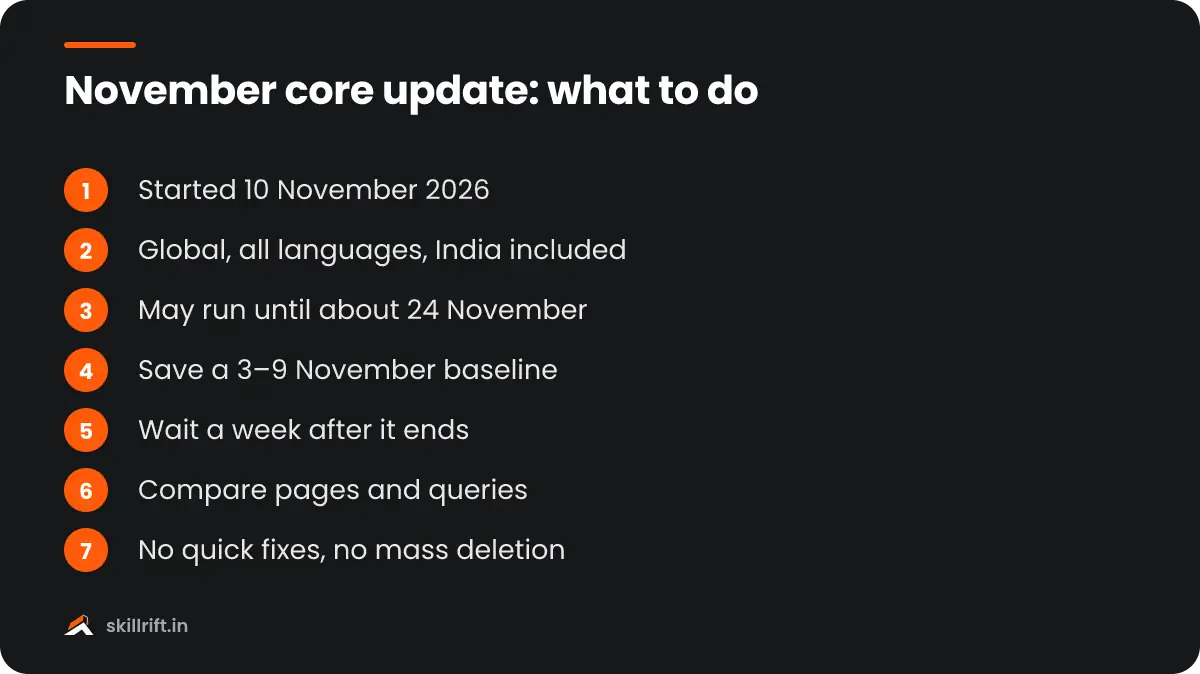
Google’s November core update is a broad change to how Google Search ranks pages, released on 10 November 2026 for all countries and languages, including India. Google says the rollout may take up to two weeks, so rankings can keep moving until about 24 November. Do not change your site in a hurry: wait for it to finish, then measure.
What is Google’s November core update?
It is the third core update of 2026 and it re-assesses how pages are ranked across the whole of Google Search. It does not target one site, one niche or one kind of spam.
Google’s Search Status Dashboard lists the “November 2026 core update” as starting on 10 November 2026, with no end date yet. Search Engine Roundtable reported Google’s announcement on LinkedIn, which described it in one line:
This is a regular update designed to better surface relevant, satisfying content for searchers from all types of sites.
Google Search Central, LinkedIn announcement, as reported by Search Engine Roundtable
Google has not said what this update changes in detail. That is normal. Its core updates documentation says these updates are broad and do not target specific sites or individual pages.
When did the update start in India?
It started late on the night of 10 November in India. PPC Land reports that the dashboard logged the release at 10:06 am Pacific time, which is 11:36 pm IST the same day. So for Indian sites, 11 November is the first full day of data under the update.
Does it apply to Hindi and other Indian languages?
Yes. PPC Land quotes the dashboard entry as saying the update applies globally and to all languages. Hindi, Tamil, Bengali and Hinglish pages are covered the same way as English ones.
Free playbook
Get the free SEO Playbook
A 25-page guide covering keyword research, content, on-page and technical SEO, Core Web Vitals, local SEO in India, link building, AI search and a 90-day plan. We email it to you, plus occasional new guides. Unsubscribe anytime.
How long will the November core update take to finish?
Google says up to two weeks, which puts the latest expected finish around 24 November 2026. Core updates often end a little earlier or later than the estimate.
The Search Status Dashboard shows how long the recent ones ran:
| Core update | Start date | Rollout time |
|---|---|---|
| December 2025 | 11 December 2025 | 18 days, 2 hours |
| March 2026 | 27 March 2026 | 12 days, 4 hours |
| May 2026 | 21 May 2026 | 11 days, 21 hours |
| November 2026 | 10 November 2026 | Still rolling out (up to 2 weeks) |
The timing matters for online stores. If the rollout ends on 24 November, it finishes three days before Black Friday on 27 November, and in the middle of India’s wedding-season shopping. Rankings may be unsettled just when search demand is high.
What should you do while the update is rolling out?
Watch and record, but do not rebuild anything. Rankings can rise and fall several times during a rollout, so a drop on day three may be gone by day ten.
Step 1: Note the start date in your reports
Add an annotation for 10 November 2026 in your tracking sheet or dashboard. Anyone reading the report later will know why the numbers moved.
Step 2: Save a baseline from before the update
Export clicks, impressions and average position from Search Console for 3 to 9 November. This is the week you will compare against later. It includes Diwali on 8 November, so also export the same dates from last year to judge what is seasonal.
Step 3: Check the dashboard for the end date
Open the Search Status Dashboard every few days. The update is finished only when Google adds an end date to the entry.
Step 4: Wait one full week, then compare
Google’s documentation says to wait at least a full week after a core update completes before analysing your site in Search Console. If the rollout ends on 24 November, your first fair comparison is around 1 December.
Step 5: Look at pages and queries, not the site total
Find the pages and search queries that moved most. Check Web, Images, Video and News results separately, as Google advises. Our Google Analytics 4 setup guide shows how to confirm the same change in organic traffic and leads.
How do you know if the core update hit your site?
You were affected if organic clicks and positions changed clearly from 11 November onward and stayed changed after the rollout ended. A dip that lasts two days is not a verdict.
Use this simple reading of the numbers:
- Positions moved by one or two places: Google says a small drop needs no drastic action. Keep publishing.
- A few pages fell sharply: review those pages. Something better may now answer that query.
- Most pages fell and stayed down: assess the whole site against Google’s helpful content questions.
- Traffic fell but positions did not: the cause is probably not the update. Check seasonality, festival dips after Diwali, tracking and AI answers taking clicks.
Rule out technical problems as well. A broken robots.txt, a noindex tag or a slow server can look like an update hit. Run through our technical SEO audit checklist before blaming Google.
Can you recover if your rankings dropped?
Yes, but Google gives no guarantee and no fixed timeline. Its documentation says some improvements show within a few days, while others take several months, and some wait until the next core update.
A drop does not mean a penalty. In a core update nothing is “wrong” with your page in the spam sense. Other pages were judged more helpful for that search. Recovery means making your page the better answer, not removing a fault.
Google’s guidance on what to change is plain:
- Avoid quick fixes. Changing title tags or adding keywords across the site will not reverse a core update.
- Improve for readers. Add what the page lacks: first-hand detail, current prices in ₹, clearer steps, sources.
- Treat deletion as a last resort. Remove content only if it cannot be made useful.
- Ask someone outside your team to judge the page honestly against competing results.
If you write with AI tools, be strict about adding original value. Our guide on using ChatGPT for SEO without hurting rankings explains where the line is.
What does the November core update mean for Indian websites?
Indian sites are covered from day one, and the sites most exposed are the ones that add little of their own. Google has not named any affected category for this update, so no one can yet say who won or lost.
The last update gives a hint, not a prediction. PPC Land, citing Sistrix data shared by Aleyda Solis, notes that in March 2026 aggregators, directories and comparison sites took the heaviest losses. India has many such sites: coupon pages, “top 10 colleges” lists, course and loan comparison portals. If you run one, look hard at what your page offers that the original source does not.
Early tool data is also less reliable than usual. PPC Land reports that DemandSphere found Google returning spurious results on about 11% of its daily rank checks in October. So treat “winners and losers” lists from the first week with caution, and trust your own Search Console data first.
Small businesses with a real location and real customers have less to fear. Keep your profile, reviews and service pages current, as covered in our SEO guide for small businesses.
Our Take
Do nothing dramatic until the first week of December. In our view the biggest damage from core updates comes from panic edits made in the middle of a rollout: people rewrite titles, delete posts and change URLs, and then cannot tell what caused what. Spend this fortnight on one useful job instead. List your ten most important pages and ask for each one, “What here could a reader not get from the other top results?” If the honest answer is “nothing”, that page is your first project in December.
Common mistakes to avoid during a core update
The usual mistake is acting on incomplete data. These are the ones to avoid:
- Judging results mid-rollout. Positions are not final until Google marks the update complete.
- Deleting or noindexing pages in bulk. You may remove pages that would have recovered.
- Chasing “recovery tricks”. No disavow file, schema tweak or word-count change undoes a core update.
- Comparing the wrong weeks. Compare a full week after completion with the week before 10 November, and remember that week included Diwali on 8 November.
- Ignoring wins. If pages rose, study why. They show what Google rewards on your site.
- Trusting tool screenshots over your own data. Third-party visibility scores are estimates.
Key takeaway: Google’s November core update began on 10 November 2026 and may run until about 24 November. Record your baseline now, wait a week after it ends, and then improve the pages that lost ground by making them more useful, not by quick fixes.
Reading an update calmly is a core SEO skill, and interviewers ask about it. The SkillRift SEO course covers Search Console analysis, content quality and recovery planning with Indian examples.
Frequently asked questions
Is the November core update a penalty?
No. A core update is a broad re-ranking, not a manual action or a spam penalty. If your pages dropped, other pages were judged more helpful for those searches. You will not see any message about it in Search Console.
How long should I wait before making changes?
Wait until Google marks the update complete on the Search Status Dashboard, then at least one more full week. For this update that means around 1 December 2026 if the rollout ends on 24 November.
Will my rankings come back on their own?
Sometimes. Positions often shift again before a rollout ends. If a large drop remains a week after completion, improve the affected pages. Google says the effect can take from a few days to several months to show.